








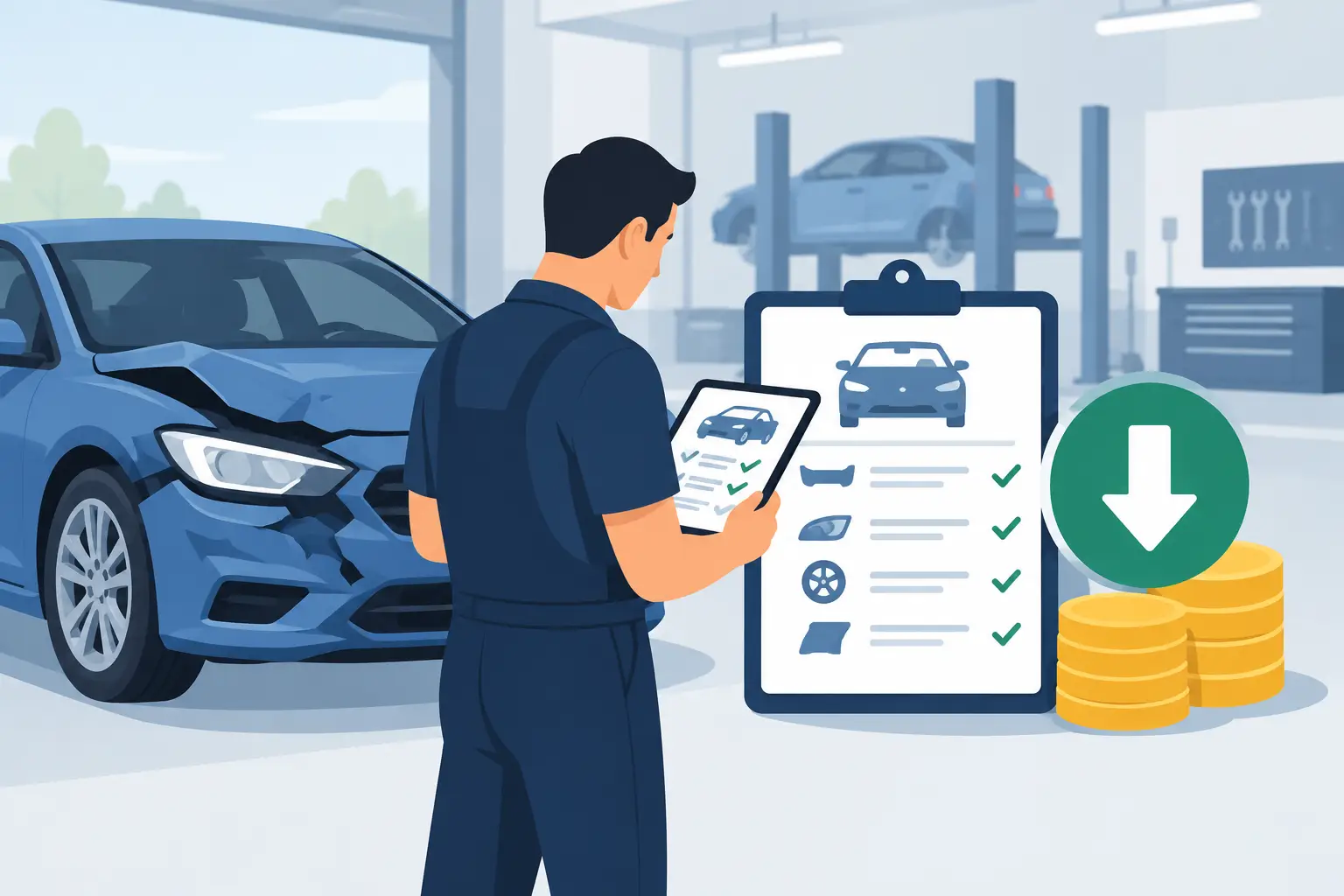

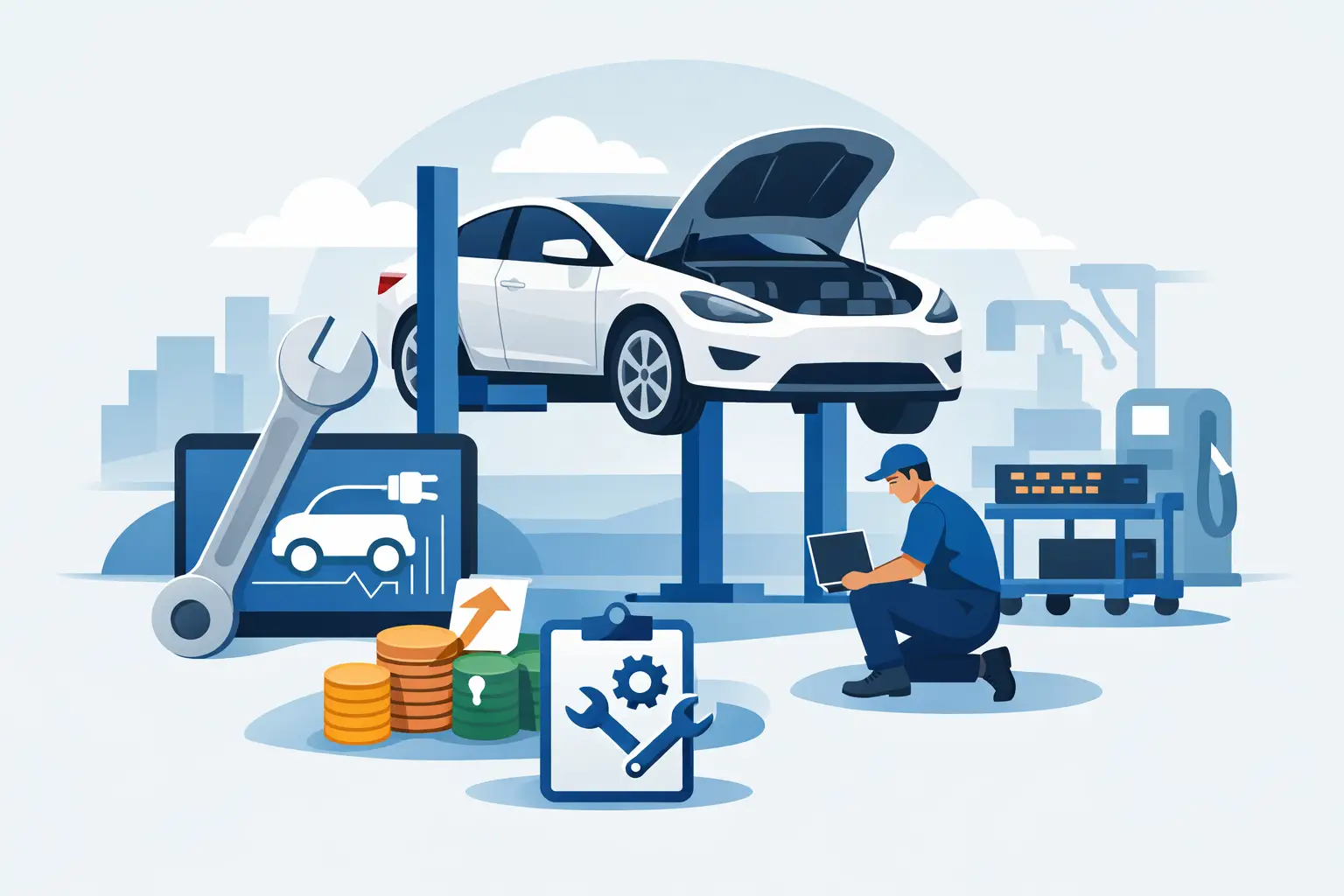
A late-model EV can arrive with a modest-looking impact and still require a repair plan that reaches far beyond conventional body, mechanical, and refinish work. The visible damage may be limited to a bumper, wheel, or quarter panel. The operational question is whether the event also affects high-voltage isolation, battery enclosure integrity, thermal management, advanced driver-assistance systems, or OEM-required procedures. That is why EV repair costs are increasingly a claims-economics and capacity issue, not simply a line-item pricing discussion.
For repairers, insurers, and vehicle owners, the headline figure is often misleading. EV severity is shaped by diagnosis, handling requirements, parts availability, calibration dependencies, labor specialization, and the possibility that a repairable vehicle becomes a total loss once battery-related risk enters the file. Managing the work profitably requires a more disciplined view of where costs originate and which ones a shop can control.
EV Repair Costs Begin With Safe, Accurate Triage
The first financial decision in an EV repair is usually made before teardown. A vehicle involved in a collision may require isolation, an initial high-voltage safety assessment, and a designated storage location while the shop determines whether it can be safely moved, charged, powered down, or repaired.
That process consumes space, trained labor, and time. It can also create friction in facilities designed around fast keys-to-keys movement. A shop that has one qualified technician, limited EV staging capacity, or no clear post-collision intake protocol can see cycle time extend before parts are ordered or structural work begins.
Battery status is central to the decision. A damaged pack, compromised enclosure, coolant leak, warning indicator, or suspected high-voltage fault may trigger OEM inspection requirements and, in some cases, require a dealer or specialized service provider. Even when the battery is not damaged, documentation proving that it was assessed can be material to repair planning, insurer confidence, and liability management.
This is where estimating discipline matters. Shops should separate diagnostic operations, safety procedures, OEM research, scans, and calibration planning rather than absorbing them into an undifferentiated labor allowance. The goal is not to inflate an estimate. It is to establish a repair file that reflects the actual work, risk controls, and equipment use required by the vehicle.
The Cost Stack Extends Beyond the Battery
Battery replacement attracts attention because it can be one of the largest EV repair expenses. But the pack is not the only source of severity. In many repairable claims, the cost stack is distributed across systems that are familiar individually but more interconnected on an EV.
A front-end impact, for example, can involve cooling components, active grille shutters, radar sensors, camera mounts, wiring, charge-air or thermal circuits, and underbody panels. A curb strike can create questions around wheels, suspension, high-voltage cabling, battery shields, and alignment angles needed to support ADAS calibration. A rear collision may require scrutiny of structural areas near the pack and charging-system components.
Parts pricing and availability add another variable. EV platforms can have lower volume than comparable internal-combustion models, and certain assemblies may be available only through OEM channels. When a component is backordered, a repairer faces a cycle-time problem that is only partly visible in the estimate. Rental exposure, customer communication, storage constraints, and work-in-process aging all follow.
The repair-versus-replace decision can also be more restrictive. OEM procedures may limit sectioning, welding, straightening, or refinishing around battery-adjacent areas. Some aluminum-intensive structures and sealed battery enclosures leave less room for improvisation. A facility must have the required tooling, documented procedures, and technician competence to perform the operation, or it must sublet or refer the work.
Why EV Claims Severity Does Not Follow a Single Pattern
It is tempting to treat EVs as uniformly more expensive to repair. The reality is more segmented. A low-speed cosmetic repair on an EV without sensor, cooling, or high-voltage involvement may look much like work on any premium late-model vehicle. Conversely, a conventional vehicle with extensive structural damage can exceed the cost of an EV claim.
What differs is the volatility of the EV file. A relatively small discovery during disassembly can materially alter the repair path. A damaged battery tray, a fault that cannot be cleared until further testing, or an OEM directive requiring replacement of a component can change the severity calculation quickly.
Vehicle age also matters. As the EV parc matures, repairers and insurers will encounter more vehicles outside early ownership cycles, with lower actual cash values and a wider range of parts conditions. This can push more claims toward total loss decisions, particularly where a battery assembly represents a large share of pre-loss value.
Salvage handling adds another layer. High-voltage vehicles require informed decisions about storage, transport, dismantling, and downstream disposition. Recycling and salvage partners with battery-specific capabilities will become increasingly relevant to carrier recovery strategies and to the industry’s ability to keep repairable components in circulation safely.
Labor, Tools, and Capacity Are the Margin Equation
The most durable response to rising EV repair complexity is not simply purchasing more equipment. It is matching investment to local vehicle population, repair mix, OEM affiliations, and insurer relationships.
A collision center with meaningful EV volume may need insulated tools, high-voltage personal protective equipment, scan capability, battery lifting or support equipment, dedicated barriers, fire-response planning, and access to current OEM procedures. Mechanical facilities may face a different mix, including service information subscriptions, battery cooling diagnostics, charging-system testing, and technician certification pathways.
The larger constraint is qualified labor. High-voltage training is not a one-time credential. Procedures vary by manufacturer, vehicle architecture, and task. Shops need clear rules around who may depower a vehicle, inspect high-voltage components, perform post-repair verification, and release the vehicle. They also need a plan for vacation coverage, turnover, and the practical reality that a single trained employee is not a scalable operating model.
For multi-shop operators, concentration may be more economical than universal capability. Designating EV-capable hubs can concentrate equipment, training, and technician experience while allowing satellite locations to manage intake, estimating, and controlled transfers. The trade-off is towing expense and potential customer inconvenience. In markets with dense EV penetration, however, distributed capability may be necessary to protect cycle time and insurer scorecards.
Estimating and Documentation Need Tighter Controls
EV repair costs are often disputed when the documentation trail is weak, not when the operation itself is unreasonable. Estimators need a repeatable workflow that begins with identifying the exact vehicle configuration and moves through OEM procedure research, pre-repair scanning, damage mapping, teardown, repair-plan updates, and post-repair validation.
The repair plan should clearly distinguish collision damage from pre-existing faults, normal maintenance needs, and unrelated warning lights. It should also identify which operations are required by the manufacturer and which are shop process decisions. That distinction helps claims teams evaluate the file and reduces avoidable supplements.
Calibration planning deserves special attention. A vehicle may need wheel alignment, static calibration, dynamic calibration, or several of these operations after repairs involving sensors, suspension, glass, bumpers, or structural components. The cost is not merely the calibration charge. It includes scheduling, space, target equipment, road-test conditions where applicable, and the risk of rework if the vehicle is released without a complete validation process.
Claims Partners Must Plan for Longer Decision Cycles
Insurers have a parallel operational challenge. Fast appraisal models built around visible damage can struggle when EV safety review and OEM research are still underway. Pressure to establish early severity is understandable, but premature repair-versus-total-loss decisions can create supplements, delays, and customer dissatisfaction.
Carriers, DRP partners, and independent repairers benefit when escalation thresholds are defined upfront. Those thresholds might include battery proximity, underbody strikes, coolant intrusion, high-voltage warnings, deployed restraints, or structural damage in restricted repair zones. A consistent escalation path gives adjusters a basis for involving specialists before the claim stalls.
The same principle applies to towing and storage vendors. A repair ecosystem is only as prepared as its handoffs. If a vehicle is moved without appropriate information about its condition, state of charge, or damage indicators, costs and risk can escalate outside the repair facility.
The Practical Opportunity Is Better Repair Intelligence
EV volume will continue to rise unevenly by region, brand, and vehicle segment. That makes blanket assumptions unhelpful. A suburban independent shop may see a manageable number of EVs but still need a credible intake and referral process. A high-volume collision network in a coastal metro may need dedicated EV lanes, deeper OEM relationships, and a more formal battery-event protocol.
The operators best positioned for the shift will treat EV work as a business system. They will measure touch time separately from administrative delay, track supplements tied to diagnostics and parts, audit training coverage, and evaluate whether sublet spending reflects a temporary gap or a strategic make-versus-buy decision.
The next useful step is not to predict a single average repair bill. It is to identify where an EV claim becomes operationally different inside your own business, then build the procedures, partnerships, and pricing discipline needed to keep that difference from becoming unmanaged cost.