








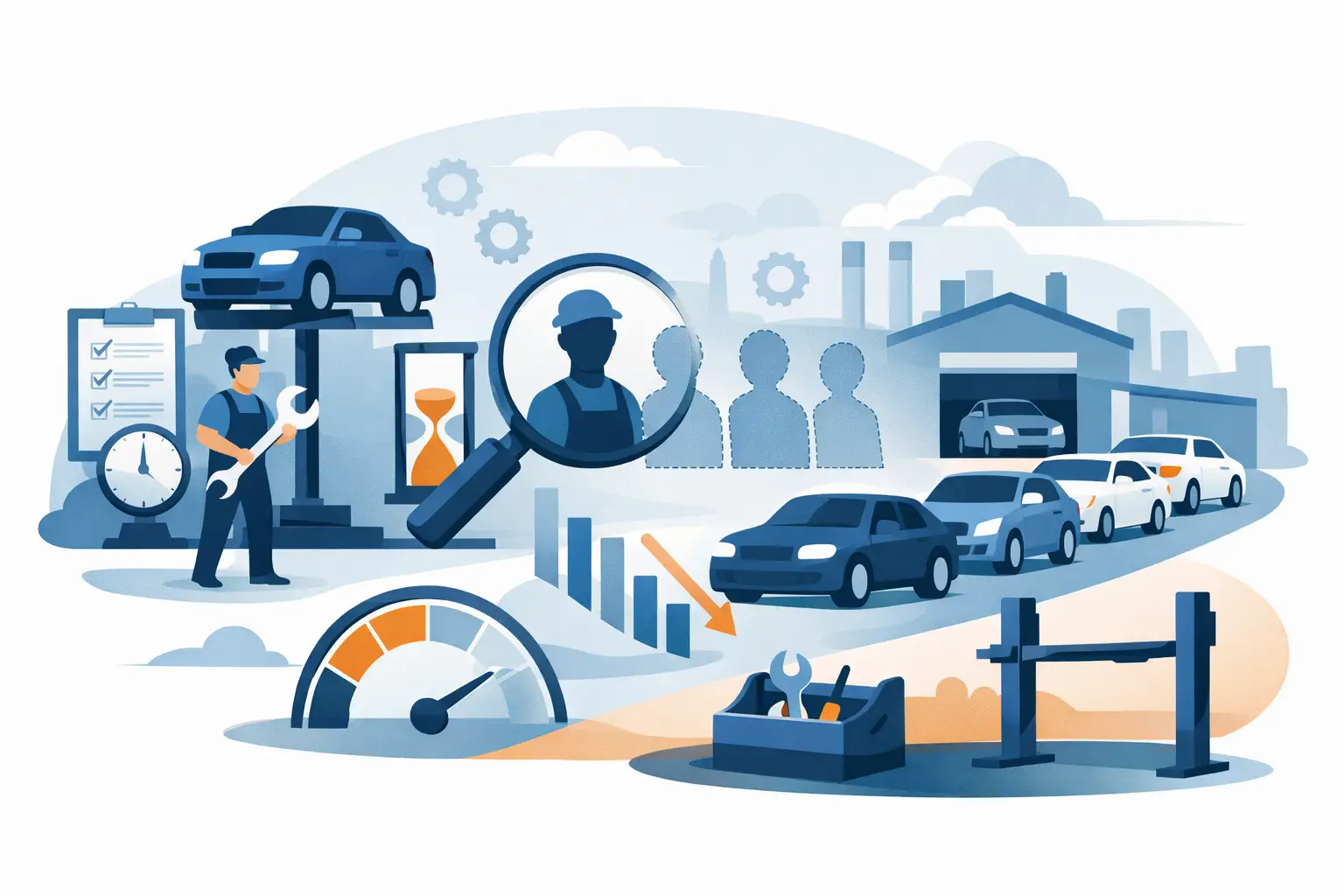
A repair facility can have approved estimates, parts availability, open bays, and strong car count – then still miss its production plan because the technician, painter, diagnostic specialist, or estimator needed to move the job is unavailable. Repair labor shortages have moved beyond a hiring concern. They are now a direct constraint on capacity, cycle time, claims performance, and margin.
For collision and mechanical operators alike, the operating question is no longer simply how many people are on payroll. It is whether the business has the right skills at the right production points, with enough predictable coverage to keep work from accumulating between teardown, diagnosis, parts, repair, refinishing, calibration, quality control, and delivery.
Repair Labor Shortages Are Reshaping Shop Economics
The labor issue is often described as a technician shortage, but that label is too narrow for the current operating environment. Collision centers need structural technicians, refinish talent, estimators, blueprinters, parts personnel, ADAS calibration capability, and front-office staff who can keep customers and insurers informed. Mechanical shops face similar pressure across diagnostics, drivability, hybrid and EV service, fleet maintenance, and service advising.
A shortage in any one role can reduce the output of the entire production system. A capable body technician cannot close a file if scanning, sublet coordination, parts reconciliation, or final calibration is delayed. Likewise, a general repair shop with full technician stalls can lose productive hours when one diagnostic specialist becomes the bottleneck for complex electrical cases.
That makes labor scarcity more expensive than a vacant position. It creates work-in-process buildup, inconsistent promised dates, overtime dependence, and avoidable friction with carrier partners, fleet accounts, and retail customers. In a market where repair complexity continues to rise, shops cannot reliably solve the problem by asking existing employees to produce more indefinitely.
The Cost Shows Up in Throughput Before It Hits Payroll
Wage pressure is visible on the income statement, but the larger economic effect is frequently hidden in production performance. Extended keys-to-keys, jobs waiting for approvals or specialized operations, and repeated handoffs all tie up capacity. For collision repairers, those delays can affect DRP scorecards, rental duration, customer satisfaction, and the ability to accept additional work.
For independent mechanical repair facilities, the equivalent problem may be a growing appointment backlog or a rising share of jobs that require a second visit. Neither outcome is necessarily caused by weak demand. Both can signal that the shop has more work than its labor model can convert into completed repairs.
The answer is not always to add headcount. A high-volume collision center with weak blueprinting discipline may hire technicians only to feed them incomplete repair plans. A mechanical shop may recruit another A-tech when its more immediate need is a service advisor who can improve dispatch quality, estimate authorization, and customer communication. Labor plans have to be tied to the actual constraint.
Find the Constraint Before Adding Labor
The most useful first step is to map where repair orders wait. This does not require an enterprise-level transformation project. Operators can review daily production boards, technician clocking, appointment schedules, supplement frequency, parts holds, sublet turnaround, and quality-control rework to identify where jobs lose time.
In collision, the constraint may sit upstream in disassembly and blueprinting, particularly on vehicles with hidden damage or multiple required scans and calibrations. If the repair plan is incomplete at the start, every downstream department inherits uncertainty. If it sits in refinishing, the business may need to review booth utilization, prep staffing, painter workload, and scheduling rather than assume body labor is the limiting factor.
In mechanical service, diagnostic capacity deserves the same scrutiny. Modern vehicles often require network analysis, software access, module programming, and interpretation of scan data that goes beyond code retrieval. When diagnostic work is treated as an interruption rather than a scheduled production operation, experienced technicians become a shared resource with no protected capacity.
Measure Skill Coverage, Not Just Headcount
A productive labor plan distinguishes between people who can perform a task and people who are currently assigned, equipped, and authorized to perform it. This matters more as repair procedures become more specialized.
A shop may technically employ five technicians but have only one person qualified to weld a particular substrate, perform advanced electrical diagnosis, conduct a required calibration, or sign off on a repair process. That is not five units of interchangeable capacity. It is a business with several single points of failure.
Leadership teams should identify roles where one absence can materially disrupt production. Cross-training can reduce that exposure, although it comes with a trade-off. Training a broader bench takes time away from immediate billable output, and not every technician should be pushed into every specialty. The goal is practical coverage for recurring work, not artificial role uniformity.
Build a Labor Model That Retains Experienced Talent
Recruitment matters, but retention often provides the faster capacity gain. Replacing an experienced technician can require months of recruiting, onboarding, tooling, process training, and quality supervision. During that period, the remaining team typically absorbs more work, which can accelerate the burnout that caused turnover in the first place.
Pay remains central, particularly as dealerships, fleets, industrial employers, and other skilled trades compete for the same technical talent. But compensation alone rarely resolves a poor daily operating experience. Technicians also evaluate dispatch fairness, estimate quality, parts readiness, equipment access, paid training, schedule predictability, and whether management protects them from preventable rework.
For multi-shop operators, standardization can help if it removes administrative friction and creates visible advancement paths. It can hurt if centralized decisions ignore local labor markets or reduce technicians to utilization metrics without addressing the reasons flagged hours are hard to convert. Independent operators can compete by offering faster decision-making, a stable culture, and a clearer connection between individual performance and reward.
Training Must Connect to the Production Plan
Apprenticeships, school partnerships, and manufacturer or supplier training are necessary long-term investments. They are not immediate substitutes for experienced technicians. A sustainable program gives entry-level employees defined work, close supervision, progressive skill milestones, and a credible wage path. Sending a new hire into general production without structure usually transfers the training burden to already overloaded senior technicians.
The strongest programs link development to work the shop expects to perform. A collision business increasing aluminum repair, ADAS-related operations, or EV volume should build training around those needs. A mechanical shop serving fleets may prioritize preventive maintenance workflows, medium-duty systems, or diesel diagnostics. Broad training libraries have value, but targeted competency development produces a clearer operating return.
Shops should also reconsider who performs non-repair work. Parts receiving, photo documentation, vehicle movement, customer updates, supplement administration, and basic prep can consume skilled labor when support roles are thin. Reallocating those tasks does not diminish the technician role. It protects technician time for the work that requires technical judgment and generates repair revenue.
Technology Can Expand Capacity, but It Cannot Replace Process
Digital estimating, production management systems, remote diagnostics, workflow automation, and calibration partnerships can improve labor leverage. Their value is highest when they eliminate repeat work, missing information, and unnecessary handoffs.
However, technology investments can also create new friction when tools are added without workflow ownership. A scan platform does not resolve a labor gap if no one is accountable for interpreting results, documenting required operations, and moving the vehicle to the next step. Similarly, automated customer messaging can reduce inbound calls but cannot compensate for missed promised dates or unclear repair plans.
Operators should evaluate technology against a practical test: does it reduce touch time, waiting time, rework, or dependency on a single person? If the answer is unclear, the investment may be a feature purchase rather than a capacity strategy.
Capacity Planning Needs a More Honest Forecast
Repair demand remains uneven by market, weather, insurer relationships, vehicle mix, seasonality, and local competition. That is why labor decisions cannot be based only on an annual car-count forecast. Shops need a rolling view of scheduled work, backlog age, estimated labor mix, technician availability, parts risk, and sublet capacity.
Collision operators should pay particular attention to severity and repair complexity, not simply repair order volume. Fewer late-model vehicles with multiple calibrations and extensive parts requirements can consume more production capacity than a larger number of conventional repairs. Mechanical operators face a similar shift as aging vehicles create demand for service while newer vehicles require more advanced diagnostic capability.
The businesses best positioned to manage repair labor shortages will treat workforce planning as production planning. They will know where jobs wait, which skills are scarce, what work should be retained in-house, and where qualified partners can extend capacity without compromising documentation or quality.
The durable advantage will not come from filling every opening at any cost. It will come from building a repair operation where skilled people can complete more correct work, with fewer interruptions, and see a future worth staying for.