






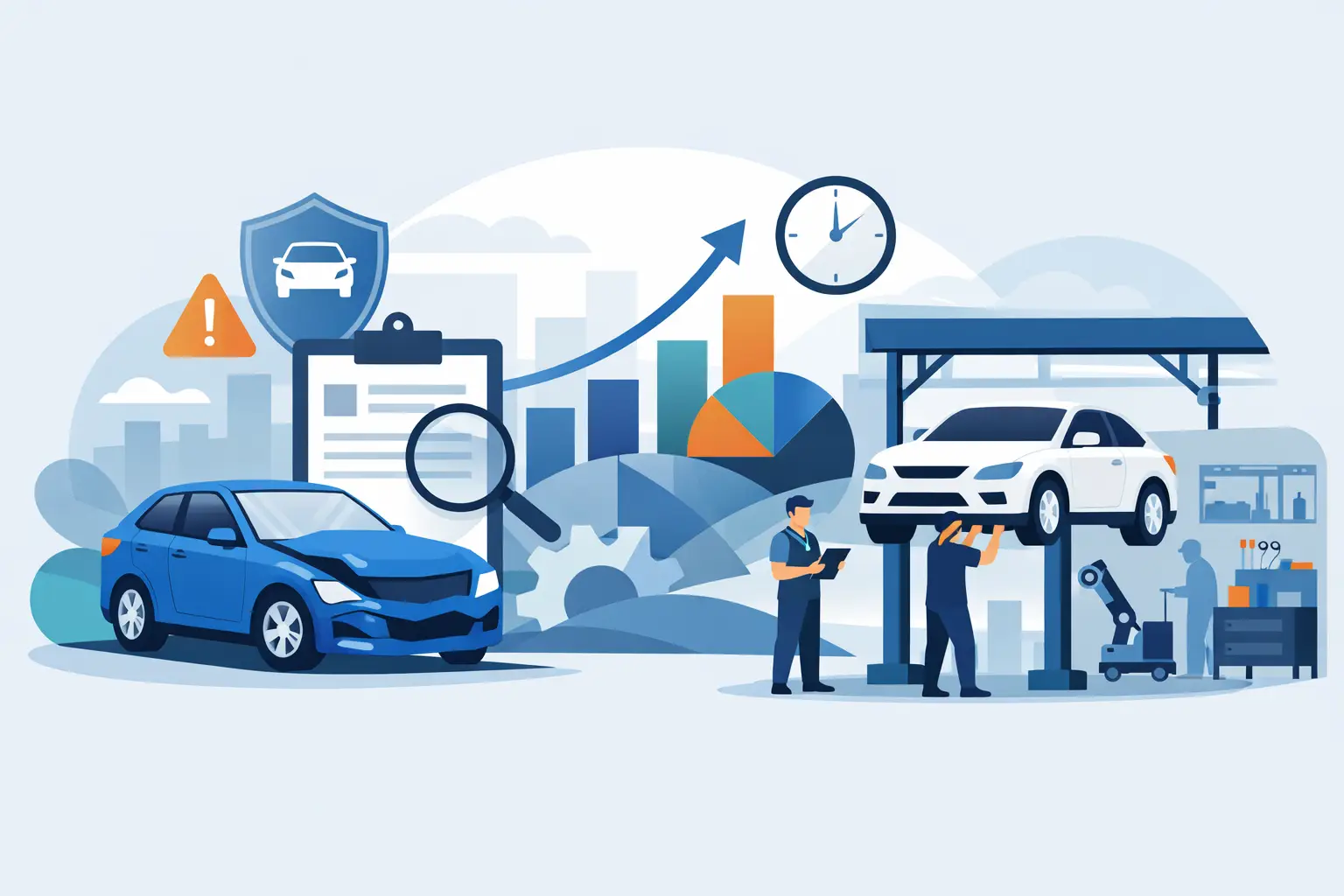
A vehicle can arrive with what appears to be a routine bumper impact and leave the estimating process with a repair plan involving radar alignment, camera calibration, structural measurement, scan documentation, and multiple parts orders. That expanding scope is at the center of automotive claims trends affecting collision operators, insurers, suppliers, and vehicle owners. The market is not defined by a single change in claim volume. It is being shaped by the interaction of higher repair complexity, uneven capacity, volatile loss costs, and faster expectations for claims communication.
For repair businesses, the practical question is no longer whether claims will become more technical. They already have. The operating question is whether the facility’s estimating, parts, production, and quality-control processes can convert that complexity into accurate, billable, cycle-time-conscious work.
Claims Economics: Severity Remains the Larger Pressure Point
Claim frequency can move with traffic patterns, weather, repairable vehicle mix, and driving behavior. Severity, however, has become the more durable planning concern. Late-model vehicles concentrate expensive components behind relatively minor points of impact: ADAS sensors, lighting assemblies, aluminum or mixed-material structures, active grille shutters, battery cooling hardware, and increasingly integrated bumper systems.
That does not mean every repair requires a full menu of procedures. It means shops and carriers need a disciplined way to identify which procedures apply to the vehicle, damage path, and OEM repair information. A missed operation can create a quality exposure; an unsupported operation can create friction in review. The best-performing claims workflows are moving away from generic assumptions and toward repair-plan documentation that connects the estimate to a specific technical requirement.
Parts pricing and availability remain part of that equation. Supply conditions have improved in many categories from the worst disruption periods, but the underlying exposure has not disappeared. A single constrained lamp, suspension component, or sensor can extend keys-to-keys even when the rest of the parts package is available. Alternative parts can help manage cost and availability in appropriate repairs, but their use depends on insurer guidelines, customer expectations, repairability, fit, warranty considerations, and the vehicle’s technology package.
For multi-shop operators, severity management is increasingly a production-management issue rather than an estimating issue alone. Blueprint quality determines whether a job enters production with a credible labor plan, parts plan, sublet plan, and calibration path. Incomplete blueprints push decisions downstream, where stalls are more expensive and customer communication is harder to manage.
Automotive Claims Trends Are Raising the Bar for Documentation
Documentation has always mattered in claims. What has changed is the volume and specificity of evidence needed to support modern repairs. Photos remain foundational, but photos alone often do not establish the need for scanning, calibrations, corrosion protection, weld testing, restraint-system work, or specialized structural procedures.
Insurers are responding with more structured estimating platforms, image analysis, rules-based review, and greater use of virtual claims handling for eligible losses. Those tools can speed low-complexity claims and improve early triage. They also create a clear dividing line: straightforward damage may be handled quickly, while repairs involving hidden damage, ADAS, EV systems, or structural concerns demand rapid escalation to a technician-informed repair process.
That distinction matters operationally. Shops that treat every estimate as a full disassembly event can consume capacity unnecessarily. Shops that rely on a preliminary visual estimate for a complex late-model vehicle risk supplements, parts delays, and production surprises. The more effective model is triage: identify the vehicles that require early scanning, targeted teardown, repair-plan review, and parts verification before they occupy a production space.
There is also a commercial dimension. Carriers want predictable severity and defensible files. Repairers need payment for documented operations and less administrative rework. Shared digital documentation can support both aims, but only when the parties agree on the evidence standard and decision path. Technology does not resolve disagreement by itself. Clear repair procedures, trained reviewers, and timely communication still do the work.
AI Will Change Intake Before It Replaces Judgment
Artificial intelligence is entering claims through photo estimating, damage recognition, routing, fraud detection, communication automation, and file prioritization. Its near-term value is likely to be greatest at intake and in administrative tasks, where it can help sort large volumes of claims and identify cases that need human attention.
For collision facilities, the risk is accepting an automated preliminary estimate as a complete repair plan. Image-based tools cannot reliably see all hidden damage, confirm prior repairs, evaluate a damaged mounting point, or determine whether a vehicle-specific calibration is required after reassembly. They can reduce time to first estimate. They do not eliminate the need for a qualified blueprint and final quality-control process.
Operators should assess claims technology on its effect on touch time, supplement rate, estimate-cycle time, and administrative burden. A tool that accelerates assignment but produces poorly scoped work is not improving throughput. It is moving work and conflict later in the process.
Capacity Is Becoming More Specialized
The collision industry has long faced technician shortages, but automotive claims trends are making specialization more consequential. The constraint is not simply the number of body technicians. It may be a shortage of qualified structural technicians, diagnostic personnel, glass specialists, calibration access, aluminum repair capability, or EV-trained staff in a particular market.
This creates a strategic choice for independent shops and MSOs. Some will invest in internal diagnostic and calibration capacity to control scheduling and capture more revenue. Others will use mobile providers, dealership partners, or centralized calibration centers. Neither model is universally superior. Internal capability can improve control and reduce handoffs, but it requires training, equipment utilization, process discipline, and ongoing software investment. Outsourcing preserves flexibility, but it adds dependencies that must be planned into the repair schedule.
Network design is changing as a result. Insurers and repair networks are looking more closely at whether a facility can perform the work it accepts, not just whether it has geographic coverage. A shop’s ability to document OEM research, coordinate calibrations, manage EV safety requirements, and maintain repair quality may carry more weight in referral and performance discussions than raw stall count.
EV and Hybrid Claims Require Earlier Decision Points
Battery-electric and hybrid vehicles still represent a minority of the overall car parc in many markets, but their claims implications are already material. Damage involving a high-voltage system, battery enclosure, thermal-management component, or underbody structure can require a different intake sequence than a conventional collision repair.
The first issue is safety. Facilities need defined procedures for vehicle identification, state-of-charge considerations, isolation, storage, inspection, and escalation when battery damage is suspected. The second is repairability. A claim that initially appears repairable can change quickly when a battery pack, enclosure, or high-voltage component is affected and replacement costs are considered.
Insurers, salvage operators, towing providers, and repairers all have a stake in making those decisions earlier. Delayed identification can lead to inappropriate storage, avoidable handling risk, or a repair plan that is no longer economically viable. For shops, the operational lesson is to establish a clear intake trigger for EV and hybrid damage rather than treating those units as standard arrivals.
Weather Losses and Fraud Pressure Keep Claims Volatile
Catastrophic weather has increased the importance of surge planning. Hail, flooding, wind events, and regional collision spikes can rapidly overwhelm local repair capacity, parts availability, rental inventory, and claims staffing. The resulting work is not always technically complex, but the coordination burden is substantial.
Shops that participate in catastrophe response need to protect their core operations. Temporary capacity can generate revenue, yet it can also disrupt scheduled customer work, strain quality controls, and create staffing fatigue. The right decision depends on available leadership, physical space, parts channels, and the facility’s ability to separate surge work from standard production.
Fraud scrutiny also remains elevated across the claims ecosystem. Carriers are investing in analytics to identify questionable photos, duplicate losses, inconsistent damage patterns, inflated invoices, and organized activity. Legitimate repairers benefit when documentation is consistent, time-stamped, and tied to the vehicle and repair plan. Clean files reduce avoidable questions and help distinguish necessary repair operations from unsupported additions.
What Operators Should Watch Next
The next phase of claims management will be less about a single technology platform and more about connected decisions. Assignment, triage, estimating, parts sourcing, repair authorization, sublet scheduling, calibration, payment, and customer updates are increasingly linked. A failure at any point can raise cycle time and cost.
Repair leaders should watch four indicators closely: the percentage of jobs requiring scans or calibrations, blueprint-to-final-estimate variance, days lost to parts or sublet dependencies, and the mix of work that exceeds the facility’s current technical capability. Those measures reveal where claims complexity is creating margin leakage or production congestion.
The shops and claims organizations best positioned for the next market shift will be the ones that treat technical evidence, capacity planning, and customer communication as one operating system. Every accurate early decision gives the repair plan a better chance to hold once the vehicle reaches the floor.