




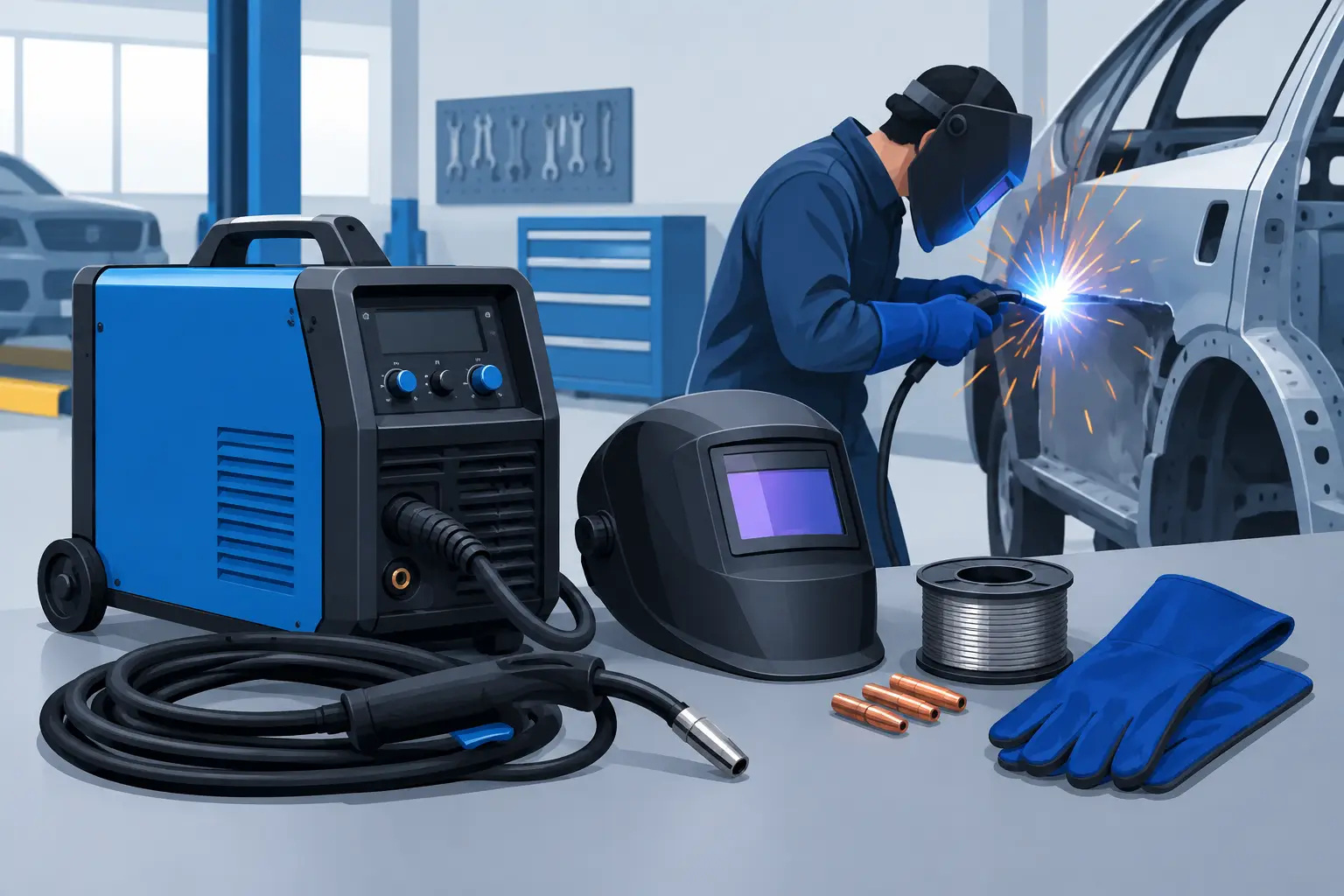
A late-model quarter-panel repair can turn on a decision made long before the vehicle enters production: whether the shop’s welding platform can reproduce the joining method specified by the OEM. For collision operators, the best automotive welding equipment is not necessarily the machine with the highest output rating or the lowest acquisition price. It is the equipment that supports documented, repeatable repairs without creating technician bottlenecks, supplement disputes, training gaps, or unnecessary sublet expense.
That distinction matters as repairable vehicles combine advanced high-strength steels, aluminum structures, mixed-material assemblies, adhesives, rivets, and electronic systems that are sensitive to heat and current paths. Welding equipment is now a production and liability decision. A shop that buys around price alone may save capital upfront while increasing cycle time, rework exposure, and OEM procedure risk for years.
Best Automotive Welding Equipment Starts With Repair Mix
There is no universal welding package for every collision or mechanical repair facility. A high-volume MSO repairing late-model unibody vehicles needs a different capability set than a mechanical shop handling exhaust, brackets, fleet fabrication, and occasional structural corrosion work. The first purchasing question is not, “What welder is best?” It is, “What work are we performing today, what work are we planning to retain, and what procedures govern those repairs?”
For most collision centers, resistance spot welding is the anchor technology for structural steel repair. Modern inverter spot welders can measure material thickness, adjust welding parameters, monitor current and force, and retain data tied to a repair. That process control is increasingly relevant where OEM procedures call for squeeze-type resistance spot welds and where insurers, repair planners, or network partners expect evidence that the required joining method was used.
MIG welding remains essential, but its role must be understood precisely. It is commonly required where access prevents placement of resistance spot welding electrodes, where plug welds are specified, and in many non-structural or semi-structural repairs. Pulse MIG capability is particularly valuable for thin-gauge steel and aluminum because it gives technicians more control over heat input and helps reduce burn-through and distortion. The value is not simply a cleaner bead. Better control can reduce downstream metal finishing, refinish labor, and rework.
Aluminum repair changes the equipment conversation. Shops repairing aluminum-intensive vehicles generally need a dedicated aluminum-capable MIG setup, correct wire-feed components, appropriate shielding gas management, and disciplined contamination controls. Using shared liners, drive rolls, or work areas without proper segregation can introduce quality problems that are difficult to see until repair performance is compromised. Aluminum capability should be treated as a process investment rather than a single-machine purchase.
TIG welding has a narrower place in many collision departments but remains useful for precision fabrication, certain aluminum repairs, specialty work, and operations supporting restoration or custom vehicle segments. For a mainstream production collision shop, TIG may not be the first investment. For facilities with a diversified repair mix, it can prevent outside dependency on low-volume, high-skill work.
The Core Equipment Categories for Collision Operations
A complete welding strategy typically involves several technologies, each aligned to OEM procedures and repair conditions:
- Inverter resistance spot welder: Required for many steel structural repairs, especially where OEM procedures specify spot welding and access permits use of a squeeze-type gun.
- MIG or pulse MIG welder: Used for plug welds, sectioning procedures, access-limited weld locations, thin material control, and general fabrication.
- Dedicated aluminum MIG system: Supports aluminum panel and structural repair while helping maintain material-specific wire-feed and contamination-control practices.
- Stud welding and dent-pulling equipment: Supports cosmetic steel repair and can reduce panel replacement in appropriate, procedure-compliant situations.
- Weld-through primer, fume extraction, and supporting accessories: These are not peripheral purchases. They influence corrosion protection, technician safety, and whether the main equipment can be used consistently on the floor.
The exact mix depends on vehicle population, OEM certifications, repair-plan mix, and the shop’s strategic position in its market. A facility that sees only occasional aluminum work may make a rational decision to sublet those repairs. A shop pursuing OEM certification, insurer program volume, or premium EV and luxury segments will usually need to control more of that work internally.
Process Documentation Is Becoming a Commercial Requirement
The strongest case for modern welding equipment is not limited to weld quality. It is the ability to standardize and document the process. A resistance spot welder that records weld parameters, identifies poor weld conditions, or supports job-level traceability offers management benefits that are often overlooked during capital review.
Documentation can support internal quality control, technician coaching, and repair-file consistency. It may also help a shop explain why a particular operation required setup time, test welds, or a specified joining process. That does not eliminate negotiation over labor reimbursement, but it gives repair planners and managers a more defensible operational record.
For consolidators and multi-shop operators, common equipment platforms can also simplify training, preventive maintenance, consumable purchasing, and technician movement between locations. Standardization is not always practical, particularly following acquisitions, but it can materially reduce variation in repair execution over time.
Capacity, Power, and Floor Layout Can Limit the Investment
Equipment specifications should be reviewed against the facility, not in isolation. Resistance spot welders may require electrical capacity that older buildings do not have available. Water-cooled systems require dependable maintenance practices. Large transformer-based or inverter units need floor space, cable management, and storage that do not interfere with vehicle movement or create trip hazards.
Shops should also assess duty cycle in relation to real production volume. A machine that performs well in demonstrations but overheats or requires frequent recovery time under sustained use can become a hidden throughput constraint. Similarly, a portable unit may be easier to move around a crowded production floor, but portability should not come at the cost of electrode force, cable durability, or access to OEM-required settings.
Fume management is another operational issue. Welding near coated metals, adhesives, seam sealers, and confined areas creates exposure concerns that should be addressed through local extraction, PPE, and written procedures. Safety investments affect retention as well as compliance. Skilled technicians are more likely to remain in shops that give them equipment capable of doing the work correctly and safely.
Training Determines Whether the Equipment Produces a Return
A sophisticated welder does not correct weak technician habits. Shops need a training plan covering machine setup, material identification, destructive test welds, electrode maintenance, wire selection, shielding gas, corrosion protection, and OEM procedure review. Training should include estimators and repair planners, not only technicians. If the front end of the repair file does not identify the necessary welding operations, the equipment’s capability may never be captured in the estimate or scheduled into the repair plan.
Managers should expect a learning curve when introducing pulse MIG, aluminum systems, or data-enabled spot welding. That transition requires protected training time and oversight. Pushing a new system directly into full production without calibration, practice panels, and process ownership usually creates frustration on the floor.
Vendor support deserves the same scrutiny as technical specifications. Ask about installation, local service coverage, loaner availability, software updates, calibration requirements, consumable lead times, and technician education. Downtime on a key welding unit can hold an entire structural repair stage, so service response is part of the total cost of ownership.
A Practical Buying Framework
Before committing capital, operators should compare prospective equipment against four operating questions:
- Does it perform the joining methods required by the OEM procedures for the vehicles we intend to repair?
- Can our electrical service, floor layout, ventilation, and maintenance process support it without disrupting production?
- Does it provide the level of weld monitoring or documentation expected by our certification, quality-control, and claims workflows?
- Can we train enough technicians to use it correctly, and can the supplier keep the unit productive when service is needed?
The answers should be tied to repair volume and retained gross profit, not a generic payback model. A high-cost aluminum welding platform may be difficult to justify for a small shop with two qualifying jobs per month. The same platform may be strategically necessary for a certified location that would otherwise lose high-severity repair volume, delay deliveries, or surrender a profitable segment to a competitor.
Equipment decisions also need to account for vehicle construction trends. Battery-electric vehicles do not make welding obsolete, but they heighten the need for accurate procedures, de-energization protocols, heat management, and protection of nearby high-voltage components. Mixed-material construction will continue to push repairers toward a broader joining toolkit rather than reliance on one familiar process.
The best purchase is the one that gives the shop a controlled path to repair the vehicles it wants to own. When equipment selection follows documented procedures, technician capability, facility readiness, and service support, welding becomes less of a capital expense and more of a durable capacity advantage.