A blueprinted late-model SUV can carry hidden structural damage, radar brackets, sensor faults, a damaged wheel, and several operations that will not appear clearly in a photo set. That is the operating reality behind AI versus human estimating in collision repair: speed at first contact has real value, but the estimate still has to support a safe, complete, profitable repair.
Artificial intelligence is moving quickly into claims intake, photo analysis, damage triage, repair-plan drafting, and supplement workflows. For carriers, it promises lower handling costs and faster cycle times. For repairers, it can reduce administrative friction and help estimators spend more time on customers, blueprinting, parts coordination, and insurer negotiations.
The issue is not whether AI will replace every estimating task. It is whether a facility and its insurer partners can define where automation is reliable, where it needs human review, and who owns the outcome when an early estimate does not reflect the actual repair.
AI Versus Human Estimating: The Real Operating Question
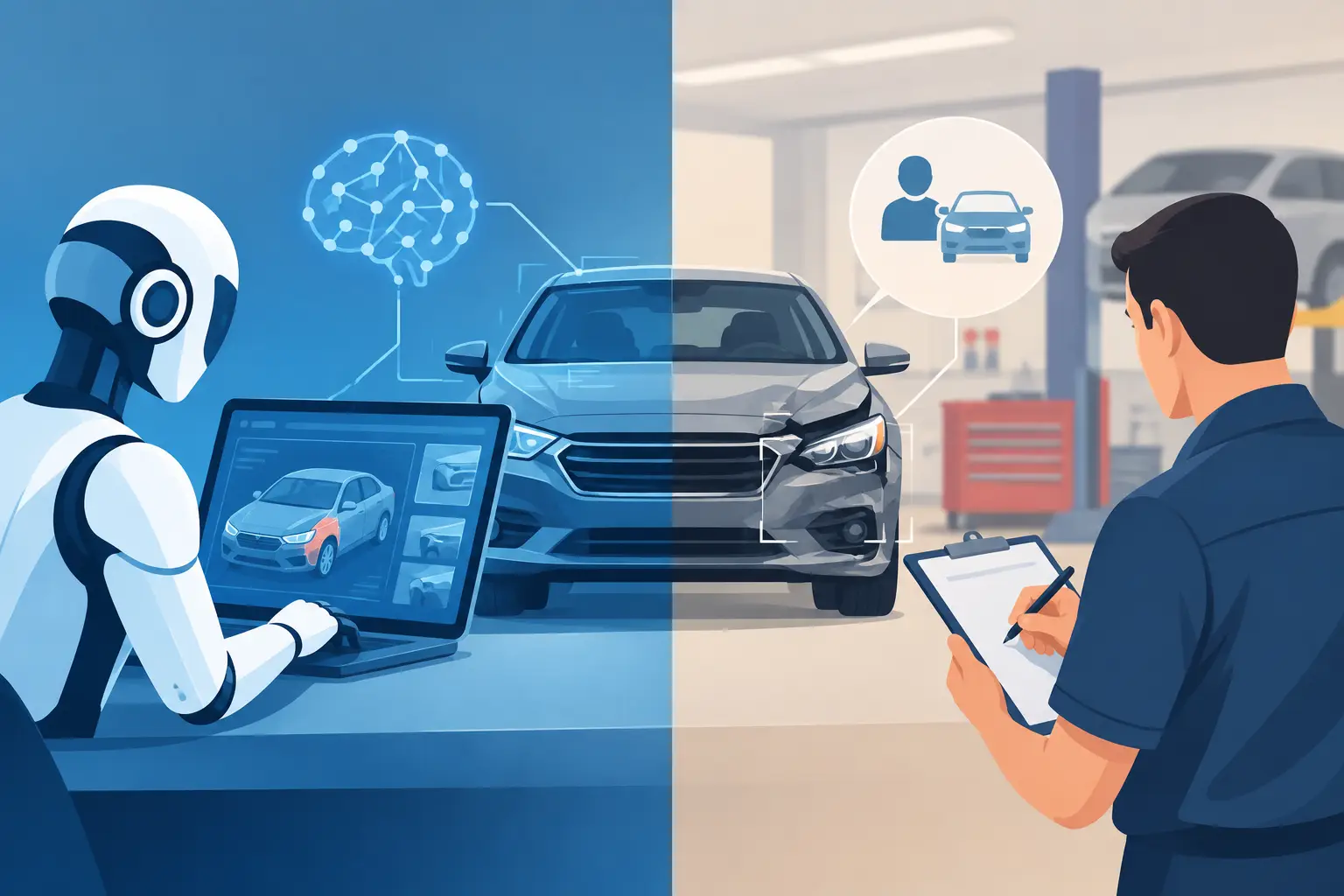
The useful comparison is not machine against estimator in isolation. It is automated damage assessment and workflow support against the full scope of professional judgment required to restore a vehicle. Those are different jobs.
AI performs well when inputs are standardized. Exterior photo analysis can identify likely panel damage, estimate severity, recognize vehicle configurations, and route a claim based on probable repair cost. That can shorten the time between first notice of loss and an initial customer response. In a high-volume DRP environment, that earlier engagement can reduce rental exposure and prevent stalled files from consuming administrative capacity.
Human estimators work in the uncertainty that begins once the vehicle reaches the shop. They reconcile visible impact with scan results, teardown findings, prior repairs, corrosion, parts availability, OEM repair procedures, and the facility’s actual production capacity. They also translate a technical repair plan into documentation that an insurer, customer, technician, and parts vendor can act on.
An AI-generated estimate can be a useful starting point. It is not automatically a repair plan.
That distinction matters more as vehicle complexity rises. A bumper cover with modest visible damage may conceal damage to active driver-assistance system components, mounts, wiring, absorbers, or calibratable sensors. A photo model can flag possibilities. It cannot inspect behind a cover, verify a diagnostic trouble code, determine whether a replacement part has arrived damaged, or observe that a previous non-OEM repair changes the procedure required today.
Where AI Can Improve Estimating Economics
The near-term business case for AI is strongest in repetitive, time-sensitive work. Estimate intake, image sorting, VIN decoding, line-item suggestions, appointment prioritization, claim status communication, and documentation checks are all areas where automation can remove low-value touches.
For an MSO, consistency may be as significant as speed. An AI-supported platform can help apply a common estimating framework across locations, identify estimates that lack required photos, flag unusually low severity scores, and surface files that merit a senior estimator’s attention. That kind of exception management can be especially useful when experienced estimating talent is scarce.
Carriers have a parallel incentive. Faster triage can separate likely repairable losses from potential total losses earlier in the process, improving assignment decisions and customer communications. When models are calibrated appropriately, they can also reduce variability in straightforward cosmetic claims.
AI may help facilities defend revenue that is already earned. Systems that compare repair documentation against common operation patterns can prompt an estimator to revisit missed scans, corrosion protection, pre-repair measurements, or calibration-related considerations. The value does not come from accepting every prompt. It comes from making omissions easier to spot before a vehicle reaches a production bottleneck or final bill stage.
Still, a suggested operation is not evidence by itself. The estimate must remain grounded in vehicle-specific condition, repairability, published procedures, and documented necessity. Shops that treat AI prompts as automatic billable lines risk creating avoidable disputes and weakening their credibility with customers and payers.
Speed Is Valuable Only When It Does Not Create Rework
A fast preliminary estimate can improve the customer experience. A fast but incomplete estimate can create a different set of problems: supplements, delayed parts orders, revised delivery dates, technician interruptions, and difficult conversations about cost or liability.
The financial effect is easy to underestimate. Each missing operation can disrupt dispatching and increase touch time across the front office, parts department, production floor, and claims file. If an estimate requires multiple rounds of clarification after teardown, the apparent efficiency of automated intake may disappear.
The right measure is therefore not only estimate turnaround time. Repairers and insurers should watch supplement frequency, time from arrival to complete blueprint, days in repair, parts-related delays, gross profit by repair order, calibration completion, and customer communication volume. An AI tool that cuts estimate-writing minutes but increases downstream exceptions has not necessarily improved throughput.
Human Judgment Remains the Control Point
Estimators do more than select labor operations. They make decisions under incomplete information, often while balancing repair quality, insurer requirements, customer expectations, and a shop’s capacity constraints. That work relies on technical knowledge, negotiation skill, and the ability to recognize when the obvious answer is wrong.
Consider a vehicle with a damaged front corner and a low-speed loss description. An automated platform may identify bumper, lamp, fender, and blend operations with reasonable accuracy. The human estimator has to ask additional questions. Was the wheel struck? Is there suspension or steering damage? Is the headlamp repairable under the manufacturer procedure? Does the vehicle require a post-repair scan, alignment, radar aiming, or dynamic calibration? Can the facility perform those operations in-house, and if not, how will sublet scheduling affect the promised delivery date?
Those decisions become even more consequential with EVs. High-voltage battery proximity, underbody damage, isolation procedures, thermal events, and manufacturer-specific repair restrictions can turn a routine-looking impact into a highly controlled repair or total-loss evaluation. AI can assist with triage, but the risk decision requires trained people, current procedures, and a documented escalation path.
Human oversight also protects against data blind spots. Models learn from historical claim and repair data. If that data reflects older vehicle populations, incomplete documentation, narrow regional practices, or payment patterns that excluded legitimate operations, the model can reproduce those limitations at scale. A lower initial estimate may look efficient in a dashboard while shifting cost and risk to supplements, repairers, or vehicle owners.
Governance Will Separate Useful Tools From Expensive Distractions
Collision businesses should approach estimating AI as an operational system, not a standalone software purchase. Before rollout, leaders need clear rules for what the tool can draft, what requires estimator review, and what documentation must remain in the file.
A practical pilot should use a defined claim segment, such as light cosmetic damage with known vehicle-age parameters, rather than sending every repair order through the platform at once. Compare AI-assisted results with the facility’s normal process and measure the full repair cycle, not just first-estimate speed.
The pilot also needs a feedback loop. Estimators, blueprinters, technicians, and calibrators should be able to identify where the system missed damage, suggested unsupported operations, misread vehicle configuration, or created unnecessary administrative work. Technology vendors need this field-level feedback, but so do shop operators deciding whether the platform fits their workflow.
Data governance deserves equal attention. Repair and claims files may contain customer information, vehicle identifiers, photos, scan results, and business-sensitive pricing data. Organizations should understand data retention, model training practices, user permissions, audit trails, and responsibility for errors. If a carrier requires AI-generated intake, repairers should be clear about whether they can challenge the output with procedure-based documentation.
A Hybrid Model Is the Most Likely Outcome
For many collision operations, the best model will be AI at the front of the process and skilled people at the control points. Automation can accelerate intake, organize evidence, identify probable damage, prioritize files, and draft routine elements. Human estimators can focus on validation, teardown, repair planning, customer communication, and exception management.
That division of labor may also change estimator training. Newer staff will need to understand how to interrogate an AI recommendation rather than simply accept or reject it. They will need stronger grounding in OEM procedures, diagnostics, ADAS, documentation, and financial consequences. The estimator who can connect technical repair requirements to a defensible business case will become more valuable, not less.
For shop owners and claims leaders, the immediate question is simple: does the technology reduce nonproductive work without reducing repair-plan accuracy or transferring hidden cost downstream? If the answer is unclear, the implementation is not ready.
The next estimate that enters the shop may begin with an algorithm. The repair should still begin with a disciplined inspection, a verified procedure, and a professional willing to stop the file when the facts do not support the first answer.