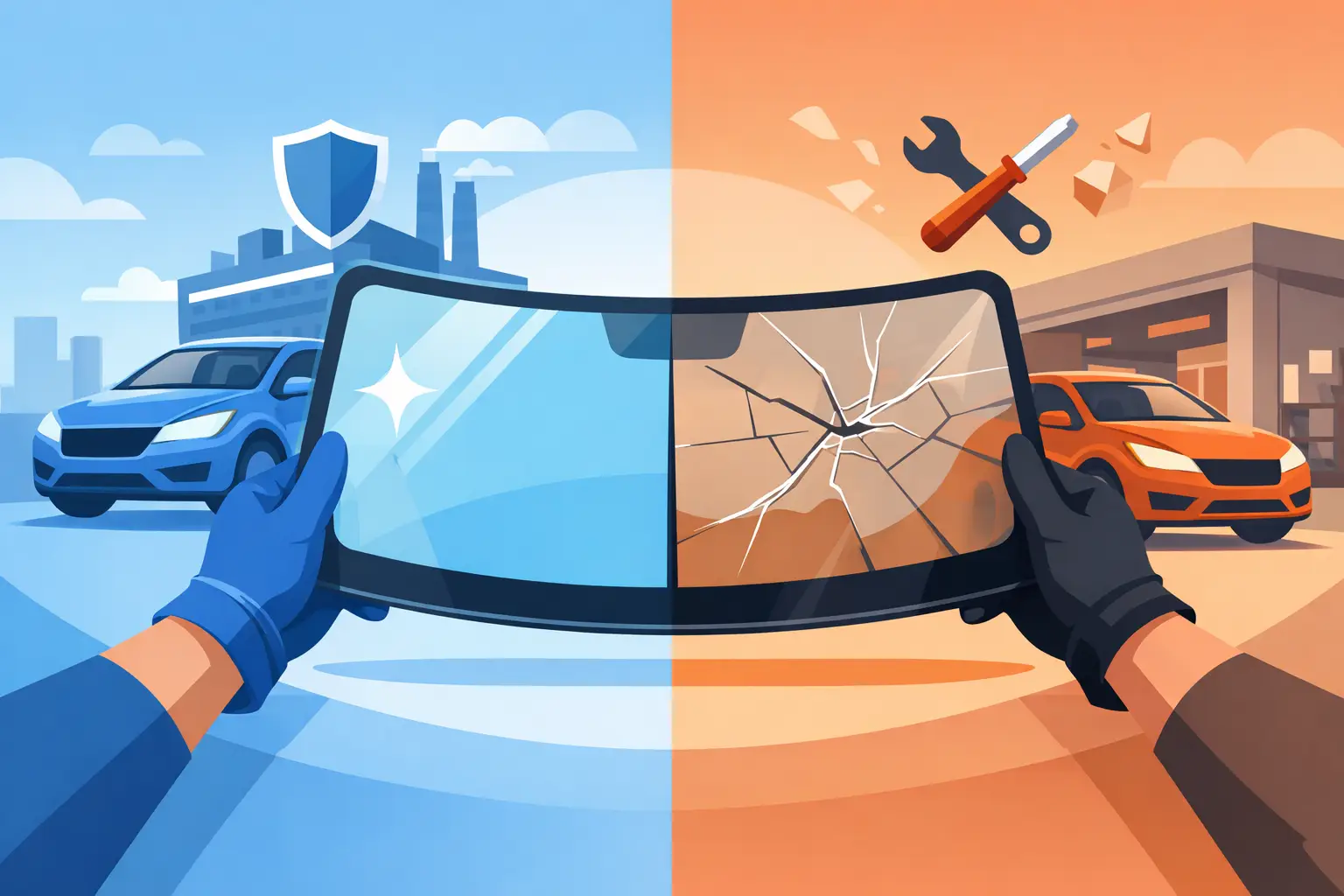
A windshield replacement can look like a straightforward line item until the vehicle reaches calibration, the moldings do not sit correctly, or a carrier challenges the invoice. OEM versus aftermarket glass is no longer simply a parts-price discussion. For collision operators, glass decisions increasingly affect repair planning, ADAS performance, liability exposure, supplement frequency, customer experience, and cycle time.
The right choice is not automatically OEM, nor is it automatically the lowest-priced aftermarket option. The operational question is whether a specific glass part can support a complete, documented repair on that vehicle under the shop’s procedures, the insurer’s requirements, and the available capacity of its glass and calibration partners.
OEM Versus Aftermarket Glass: The Business Decision
OEM glass is produced for a vehicle manufacturer or supplied through its authorized parts channel. It typically carries the automaker’s branding and is built to the vehicle program’s original specifications. Aftermarket glass is manufactured outside that branded channel, often by companies that also supply original equipment programs, but it may be produced to a separate specification, tooling set, acoustic construction, coating package, or optical tolerance.
That distinction matters because “aftermarket” is not a single quality tier. A reputable aftermarket manufacturer with a strong fitment record is not comparable to an unknown source with limited traceability. Likewise, an OEM-branded windshield is not a universal cure for every installation or calibration problem. Adhesive selection, urethane cure time, camera mounting, bracket condition, installation technique, and scan discipline remain central to the outcome.
For a multi-shop operator, the decision should be managed as a risk-and-throughput calculation. The part price is visible at estimate writing. The cost of a second installation, delayed calibration, a customer comeback, rental extension, or an unresolved ADAS fault may not be visible until much later.
Why Modern Windshields Carry More Repair Risk
Windshields have moved from passive safety components to active sensor platforms. Forward-facing cameras may support automatic emergency braking, lane-keeping assistance, adaptive cruise functions, traffic-sign recognition, and driver-monitoring systems. The glass can influence how those systems see the road through camera brackets, frit patterns, heating elements, acoustic layers, heads-up display areas, and optical characteristics.
A replacement windshield may therefore require static calibration, dynamic calibration, or both. OEM repair procedures, vehicle model year, trim level, and scan results should govern that requirement. Shops should not treat a successful dash-light check as proof that a camera system has been restored to specification.
The risk is especially acute when estimators rely on broad interchange assumptions. Two windshields that appear physically similar can differ in camera provisions, solar coating, antenna features, rain-sensor mounting, acoustic attenuation, or HUD compatibility. A part that installs may still be the wrong part.
This changes the estimating workflow. VIN-level identification, options verification, pre-repair scanning, procedure research, and calibration planning should occur before the vehicle enters the glass phase. Waiting until installation to determine whether the windshield supports the vehicle’s equipment converts a manageable planning issue into a cycle-time event.
Fit, Optics, and Feature Content Are Not Minor Details
Fit quality is often the first concern technicians raise, and for good reason. Incorrect curvature, edge geometry, encapsulation, or molding interfaces can create wind noise, water leaks, trim damage, and visual quality issues. These defects consume technician time and can undermine a customer’s confidence in the entire repair.
Optical quality deserves equal attention. Distortion in the viewing area can produce customer complaints even when the glass meets baseline safety standards. With camera-equipped vehicles, the relevant concern extends beyond driver perception to the camera’s field of view. Camera calibration may fail outright, complete with faults, or complete successfully under conditions that still warrant careful adherence to the automaker’s procedure and validation steps.
Feature content can further narrow the available choices. Heated wiper parks, humidity sensors, acoustic interlayers, infrared rejection, antenna routing, HUD zones, and camera heater elements can make a less expensive part operationally expensive if it lacks a required configuration. Estimators should document these features early, rather than assume that a generic windshield description covers the vehicle.
Claims Economics and the Documentation Gap
Insurers face legitimate pressure to control severity, and aftermarket glass can offer substantial savings in appropriate applications. For many older vehicles, non-ADAS applications, or configurations supported by a proven supplier, aftermarket glass may be a commercially sound choice. Repairers that reject all aftermarket glass on principle may limit their ability to align with customer and carrier expectations.
At the same time, an estimate authorization is not a substitute for a repair plan. If the vehicle manufacturer specifies a particular glass type, calls for calibration after replacement, or requires conditions that a selected part cannot support, the file needs clear documentation. That includes the relevant procedure, VIN-specific part selection, scan findings, calibration results, and any supplement rationale.
The key distinction is between price preference and technical feasibility. A carrier may prefer an aftermarket part, but the shop must be able to explain why a part is suitable or why it is not. Vague statements that OEM glass is “better” are less effective than documented evidence that addresses a specific feature, procedure, fitment issue, or calibration requirement.
This is also where invoice clarity matters. Glass, moldings, clips, adhesives, corrosion treatment, sublet handling, scans, calibration, and setup time should be captured according to the shop’s estimating and billing process. Bundling these operations into an undifferentiated glass line can make necessary work harder to defend.
Build a Repeatable Part-Selection Process
The most effective glass programs reduce judgment calls at the production level. Shops do not need a universal OEM-only policy or an aftermarket-only policy. They need escalation rules that tell estimators and production managers when a standard sourcing decision requires technical review.
A practical process begins with VIN decoding and confirmation of every windshield-related option. The estimator should identify camera, HUD, heating, sensor, acoustic, and antenna content; review OEM procedures; determine calibration requirements; and verify whether the selected part is documented to support the required configuration. If a calibration vendor performs the work, that partner should receive the vehicle details before glass is ordered.
Internal supplier scorecards are equally valuable. Track first-pass installation success, fit issues, optical complaints, calibration failures, delivery performance, credit handling, and total rework cost by manufacturer and vehicle application. National catalog coverage is useful, but shop-level performance data is more actionable when a manager must decide whether a lower acquisition cost is producing higher operational cost.
For networks and MSOs, this information can support preferred-supplier agreements without removing local technical judgment. A centralized glass strategy should create consistency in sourcing, documentation, and quality reporting while preserving a clear path to OEM escalation for applications that warrant it.
Supplier Relationships Can Protect Cycle Time
Glass sourcing is a supply-chain issue as much as a technical one. Availability of the correct part, moldings, clips, and calibration capacity can determine whether a vehicle leaves on schedule. A low-cost windshield that arrives late, ships damaged, or requires a second installation is not a favorable procurement outcome.
Repair organizations should evaluate suppliers on more than price and geographic coverage. Useful service measures include order accuracy, damage rates, local inventory depth, electronic invoicing quality, technical support, return turnaround, and the ability to identify feature-specific applications. Where third-party calibration is involved, coordination between the glass provider, body shop, and calibration partner should be defined before the repair begins.
There is also a staffing implication. Estimators need enough technical training to flag glass-dependent ADAS work, while technicians need a reliable path to procedure information and escalation. The goal is not to turn every estimator into a glass specialist. It is to prevent avoidable misses from moving downstream into production.
The Best Choice Is the One the Shop Can Defend
OEM glass is often the prudent choice when manufacturer procedures, complex feature content, uncertain aftermarket compatibility, or prior fitment history raise the risk of an incomplete repair. Quality aftermarket glass can be an appropriate option when the application is well-understood, the part matches required content, supplier performance is proven, and all installation and calibration requirements can be met.
The decision should be made before ordering, not after a vehicle is disassembled or a calibration stalls. A disciplined OEM versus aftermarket glass process gives repairers a better way to protect margins without treating safety systems, customer expectations, or technical documentation as afterthoughts. When the file is clear and the process is repeatable, the chosen windshield becomes easier to install, easier to calibrate, and easier to defend.