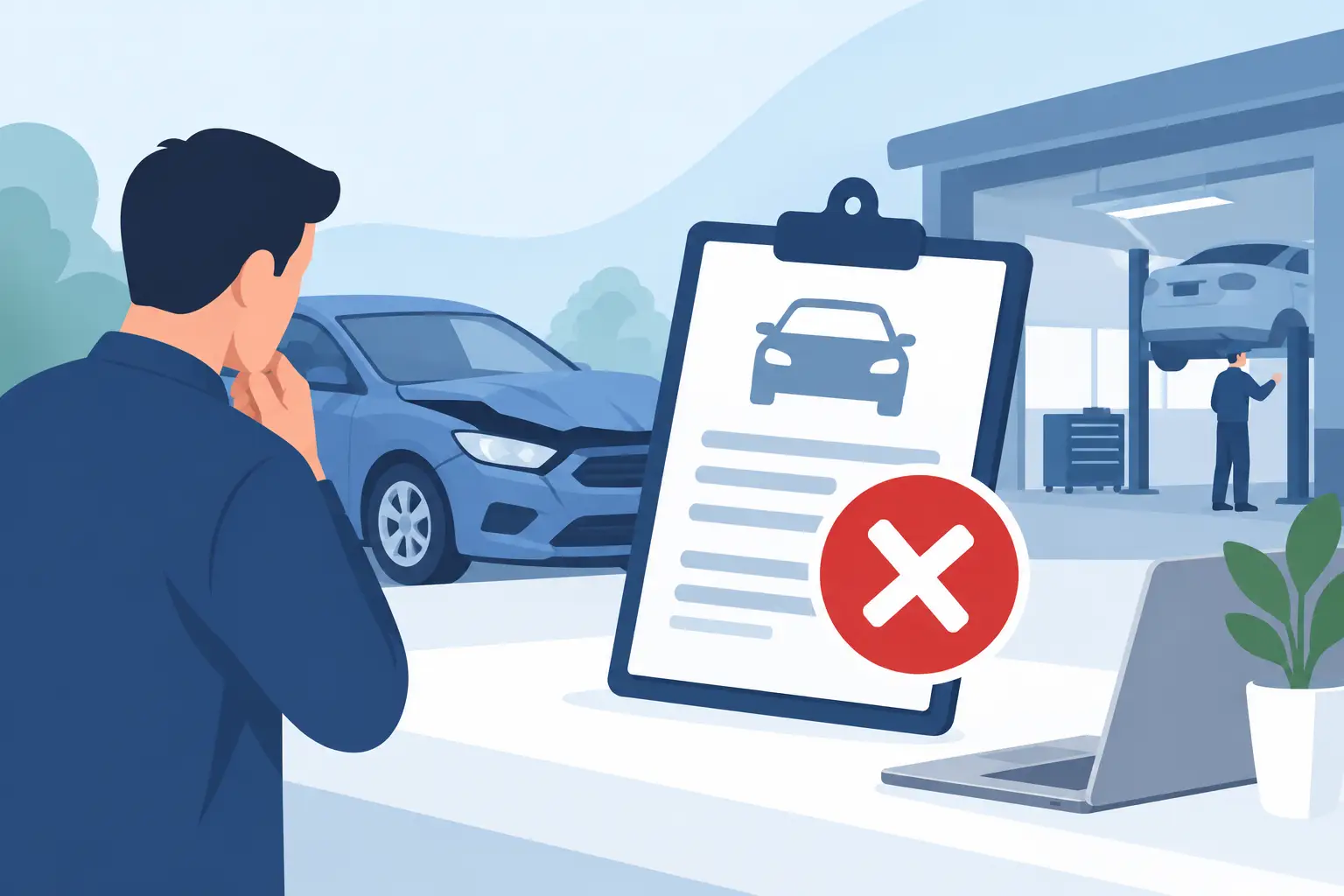
A vehicle can arrive with visible quarter-panel damage and leave the estimating process carrying a much larger operational problem: a disputed procedure, a rejected supplement, or a coverage decision that stops the repair plan cold. For repair operators, the search phrase “why claims denied” is rarely about one event. It reflects a breakdown somewhere between loss facts, policy terms, estimate logic, repair documentation, and the carrier’s claim-handling workflow.
For collision centers, denials and partial denials are more than customer-service friction. They can extend keys-to-keys time, consume estimator capacity, delay parts ordering, create unbilled technician time, and pressure gross profit when a shop performs necessary work before agreement is secured. The strongest response is not simply better negotiation. It is a disciplined process that makes repair necessity, causation, pricing, and authorization easier to verify.
Why Claims Are Denied: Separate the Denial Types
The industry often uses “denial” as a catch-all, but the operational response depends on what was actually denied. A carrier may deny the entire loss based on coverage, material misrepresentation, late reporting, policy exclusions, or a dispute over whether the damage arose from the reported incident. That is fundamentally different from an insurer declining a line item, reducing labor time, challenging a parts choice, or withholding approval for a calibration procedure.
For a repair facility, the distinction matters because the customer remains the contracting party. A coverage denial may leave the owner responsible for the repair, subject to state law and the signed repair authorization. A procedure-level dispute, meanwhile, requires the shop to establish why the operation is necessary for a safe, complete repair. Treating both situations as an estimating disagreement can lead to poor customer communication and unrecoverable work.
Partial denials are especially common in complex repairs. The estimate may be approved, while a carrier questions scan charges, OEM-required operations, corrosion protection, adhesive materials, blend panels, suspension geometry work, sublet administration, or a post-repair calibration. Each item has its own evidence standard and may move through a separate review queue.
The Main Failure Points in the Claim File
A denial does not always mean the repair is unjustified. It often means the file lacks a clear connection between the loss, the damage, and the proposed operation. That gap can arise at intake, during teardown, or after a supplement reaches a desk reviewer without enough supporting information.
Causation and prior-damage disputes
Carriers need to determine whether the claimed damage came from the reported loss. Older impact damage, unrelated scrapes, corrosion, worn mechanical components, and pre-existing warning lights can complicate that determination. Shops should not assume a damaged component is loss-related simply because it is found during repair.
Thorough intake photos, customer disclosures, pre-repair scans, measurements, and clear technician notes help establish the starting condition. When pre-existing damage is present, separating it cleanly from collision-related work protects credibility. Combining everything into one broad repair narrative may make the entire file harder to defend.
Incomplete documentation of repair necessity
Modern repair planning increasingly depends on documentation beyond the estimating database. Vehicle-specific OEM procedures, position statements, diagnostic reports, scan-tool outputs, DTC records, wheel-alignment printouts, photos of concealed damage, and invoices from qualified sublet providers can all be relevant.
The issue is not volume of paperwork. It is relevance and traceability. A generic statement that a calibration is “required” carries less weight than a repair file showing the affected system, the applicable procedure, the completed repair steps, and the successful calibration result. Similarly, an invoice for a scan is stronger when it identifies the VIN, date, service performed, and documented findings.
Estimate language that obscures the repair plan
Estimating systems are essential commercial tools, but they are not repair procedures. A line item may not fully describe setup, one-time-use materials, inspection requirements, required fasteners, or operations included or excluded by database logic. If the repair plan relies solely on an estimate line without explanatory notes, the reviewer may see an unsupported charge rather than a necessary operation.
Estimators need a repeatable way to bridge that gap. Notes should explain the condition found, the repair decision, the source supporting the operation, and the expected outcome. This is particularly important for ADAS work, structural repairs, EV-related high-voltage safety steps, and procedures involving aluminum, bonded panels, or advanced restraint systems.
Parts, pricing, and availability conflicts
Parts-related disputes remain a major source of friction. The question may be whether an OEM, recycled, aftermarket, or reconditioned component is appropriate; whether a chosen part is available; or whether a price change is documented. Availability is not static. Backorders, damaged shipments, quality issues, and fitment failures can alter the repair plan after authorization.
A shop that waits until delivery day to communicate a parts problem loses leverage and time. Document the sourcing effort, order dates, estimated arrival dates, fitment findings, and any quality concerns as they occur. When a non-OEM option cannot safely or reasonably complete the repair, the file should show why in specific terms, not just that the technician preferred another part.
Policy, payment, and authorization problems
Not every claim obstacle belongs to the repairer. Deductibles, lapsed coverage, excluded uses, rental limits, payment holds, claimant liability disputes, and policyholder cooperation issues may be outside the shop’s control. Yet they still affect repair scheduling and customer expectations.
Front-office teams should explain early that an insurer’s preliminary approval is not the same as final payment. Written authorizations, documented customer elections, and transparent conversations about deductibles and non-covered work reduce the risk that a vehicle occupies a production slot while responsibility for the bill remains unresolved.
Claims Denial Prevention Starts Before Teardown
The best time to reduce a denial is before the vehicle enters the production queue. Intake should capture a complete loss narrative, all visible damage, prior conditions, warning lamps, wheel and tire concerns, and customer expectations. This is not administrative overhead. It determines whether the shop has a defensible baseline when hidden damage appears later.
Teardown and blueprinting should follow a controlled handoff. The estimator, technician, parts team, and sublet partners need a shared understanding of what is being inspected and what evidence must return to the file. A missed photo or undocumented damaged harness can force multiple supplement rounds after the vehicle is already disassembled.
For multi-shop operators, standardization is a margin-control issue. One location may document calibrations with OEM procedure excerpts and final reports, while another submits only a labor line. The resulting variation makes it difficult to compare approval rates, supplement cycle time, and write-off exposure across the network. A common documentation standard gives management usable data rather than anecdotal complaints about individual carriers.
Build a File That Can Withstand Review
A strong file tells a chronological story. It should show the reported loss, the vehicle condition at intake, the repair plan, the discovery of additional damage, the evidence supporting each operation, communications with the payer, and confirmation that the completed work met the required standard.
That does not require estimators to become attorneys. It requires clarity. Photos should be labeled, diagnostic documents attached to the correct repair order, and supplement notes written so a reviewer who has never seen the vehicle can understand the decision. Dates matter. So do VIN-specific records and evidence that a required operation was actually completed.
Shops should also track denial reasons as operational data. A monthly review can reveal whether friction is concentrated around a specific carrier workflow, a particular procedure category, delayed supplement submission, a recurring parts supplier issue, or inconsistent internal estimating practices. The goal is not to eliminate every disagreement. Some disputes reflect legitimate differences over coverage, causation, or repairability. The goal is to prevent avoidable delays and make the remaining disputes easier to resolve.
Escalation Should Protect the Customer and the Margin
When an item is declined, the first response should be precise: request the reason, identify the documentation reviewed, and determine whether the disagreement concerns coverage, price, procedure, causation, or authorization. A vague escalation usually produces a vague answer.
If additional documentation changes the decision, the process worked. If it does not, the shop must make a commercial decision. It may seek carrier reconsideration, discuss customer-pay options, pause work pending authorization, or, where appropriate, advise the customer to pursue the matter directly with the insurer. Performing disputed work without a documented payment path can convert a claims problem into a shop write-off.
Claims denials will remain part of a repair economy shaped by more vehicle technology, more repair complexity, and tighter cost controls. Facilities that document the repair plan as carefully as they perform it will be better positioned to protect cycle time, repair quality, and the customer relationship when approval does not come easily.