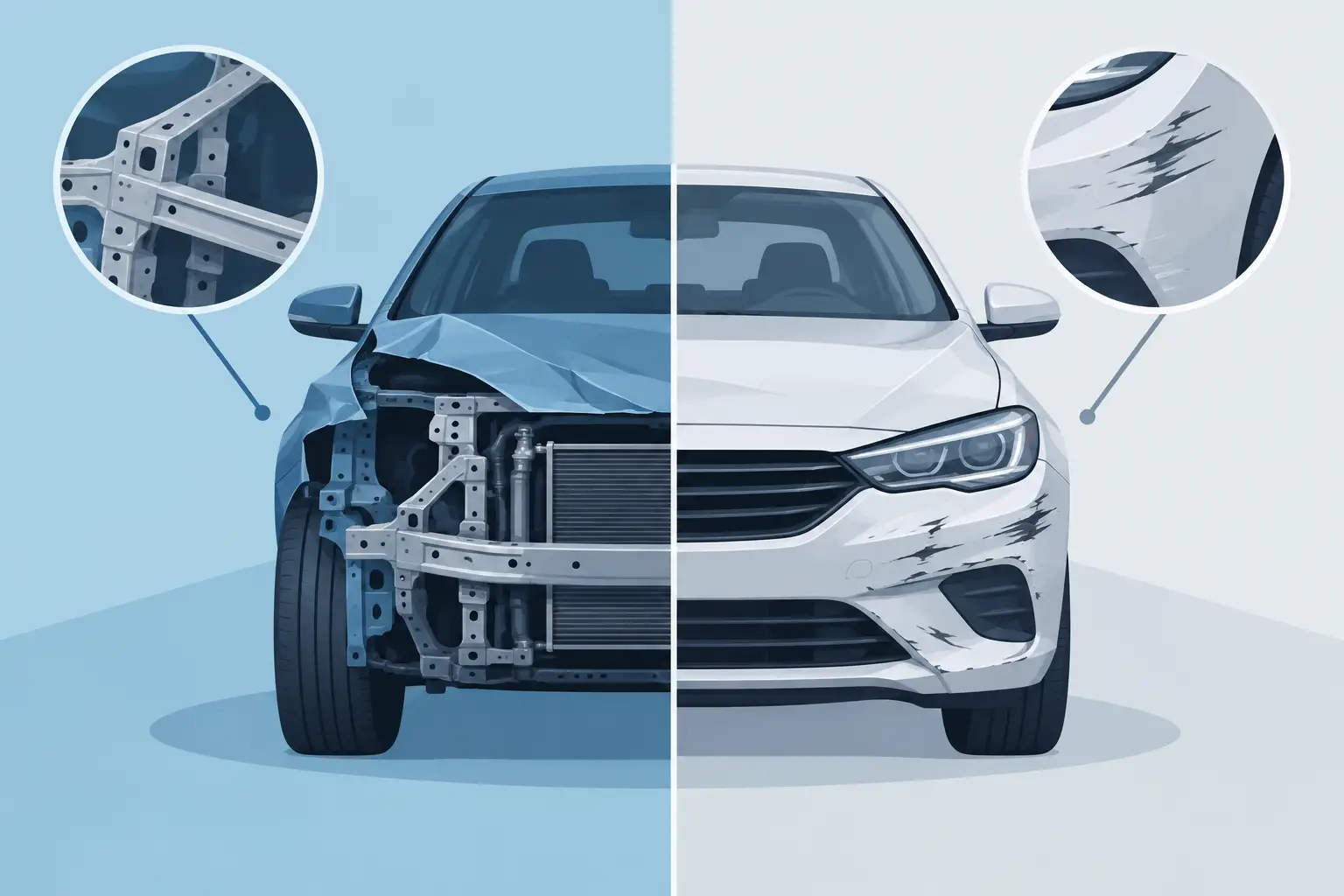
A damaged bumper cover can look like a routine refinishing job until teardown reveals a displaced reinforcement, damaged absorber, or compromised radar bracket. That gap between visible condition and repairable condition is where structural versus cosmetic damage becomes an operational issue, not simply an estimating label. For collision centers, insurers, and repair networks, the classification affects repair methodology, parts decisions, calibration requirements, cycle time, supplements, liability exposure, and the final repair bill.
The distinction is becoming harder to make from walk-around damage alone. Modern vehicles distribute crash loads through engineered structures, use mixed materials in places that once relied on mild steel, and package sensors behind exterior panels. A vehicle may retain a presentable appearance while carrying damage that requires measuring, sectioning, replacement, or OEM-directed inspection.
Structural Versus Cosmetic Damage: The Working Definition
Cosmetic damage generally affects a vehicle’s appearance without compromising its designed load paths, occupant protection systems, mounting locations, or functional systems. Common examples include paint scuffs, minor dents in nonstructural panels, cracked trim, scraped wheels, and damage limited to a bumper cover where associated components are confirmed intact.
Structural damage affects components that manage crash energy, maintain body geometry, support suspension or drivetrain assemblies, preserve restraint-system performance, or provide a stable platform for vehicle systems. This can include rails, aprons, pillars, rockers, floor structures, crossmembers, unibody attachment points, subframes, suspension mounting areas, and battery-enclosure structures on EVs. The definition also reaches beyond visible metal deformation. A distorted sensor mount, damaged active grille shutter assembly, or altered headlamp mounting point may not be structural in the traditional frame-machine sense, but it can still make the vehicle unsafe or noncompliant until addressed under documented procedures.
The key operational point is that cosmetic does not mean minor, and structural does not necessarily mean a total loss. A bumper cover repair may require expensive scanning, component removal, bracket replacement, and calibration. Conversely, a measurable structural repair can be economically viable when parts availability, labor capacity, and vehicle value support it.
Why the Classification Changes the Entire Repair Plan
Repair planning begins with a hypothesis, not a conclusion. The initial estimate records apparent damage and establishes a customer and insurer conversation. It should not substitute for a documented teardown, diagnostic process, measuring strategy, and OEM repair-procedure review.
When damage is cosmetic, the operation may remain relatively contained: remove and install adjacent parts as needed, repair or replace the panel, complete corrosion protection where applicable, refinish, and validate fit and finish. Even then, repairers must account for material identification, blend requirements, electronic content, and any required scans or calibrations.
When damage is structural, the repair plan expands. The team may need electronic pre-repair diagnostics, a full or partial teardown, dimensional measurement, restraint-system inspection, suspension assessment, corrosion-protection restoration, weld testing, and post-repair validation. The repair sequence matters because restoring an outer panel before confirming underlying geometry can create rework, conceal evidence, and delay supplement approval.
For multi-shop operators, consistency is especially valuable. A location that treats a pushed-in quarter panel as a cosmetic issue while another location automatically measures related inner structure creates uneven severity, uneven liability, and uneven gross profit. Standardized decision gates help prevent that drift.
Damage Visibility Is a Poor Proxy for Severity
The most common classification error is relying too heavily on what can be seen before disassembly. Low-speed impacts can damage energy absorbers, brackets, cooling modules, harnesses, blind-spot sensors, and reinforcement components behind an apparently modest exterior mark. Curb strikes can transfer loads through wheels and suspension into knuckles, control arms, subframes, and mounting points.
Rear-end collisions present a similar problem. A decklid or bumper may absorb attention at intake, while the meaningful question is whether the rear body panel, rail extensions, trunk floor, spare-tire well, or sensor mounting areas have moved. On trucks and SUVs, a hitch or trailer-related impact can require close attention to frame rails, receiver mounting, wiring, and rear-impact systems.
EVs add another layer. Underbody contact and side impacts can require battery-pack inspection decisions that are tightly governed by OEM procedures. Shops should not infer battery safety from the absence of warning lights or visible enclosure penetration. Isolation status, diagnostic results, inspection requirements, and manufacturer guidance determine the next step.
The Evidence That Supports a Defensible Decision
A defensible structural-versus-cosmetic determination is built from evidence that can be reviewed later by an insurer, customer, OEM program auditor, or legal team. Photos matter, but they are only one part of the file.
The strongest repair files connect the damage assessment to OEM procedures, documented measurements where required, diagnostic scan results, teardown images, parts identification, and technician notes. If a component is repaired rather than replaced, the file should support why that repair is permitted for the vehicle’s material, location, and damage condition. If a calibration is performed, the record should show the vehicle was returned to the required setup conditions and that the result passed.
This documentation also improves negotiations. Supplements are less likely to become a vague dispute when the shop can show the hidden condition, the relevant procedure, the required operation, and the consequence of omission. The conversation shifts from opinion to repairability and process compliance.
OEM Procedures Set the Boundary
A panel’s name does not determine its repairability. Two visually similar reinforcements may have different repair restrictions because of steel grade, aluminum construction, adhesive-bonded joints, sensor integration, or crash-management function. Sectioning locations, heat limits, fastener replacement, corrosion-protection requirements, and weld specifications can all vary by model year and trim.
This is where shops can lose margin by treating procedure access as an administrative cost rather than production infrastructure. Without current repair information, technicians and estimators may spend time pursuing repair paths that are prohibited, miss necessary operations, or make decisions that trigger late-stage changes. The cost shows up in stalled work-in-process, parts returns, rework, and customer-delivery delays.
Claims Economics and Total-Loss Pressure
Structural findings frequently change the claims economics because they introduce both direct operations and uncertainty. Labor hours may rise, replacement parts may be constrained, and calibrations can add scheduling dependencies. A vehicle that appeared repairable at appraisal can move toward a total-loss review after teardown exposes rail damage, restraint-system deployment, suspension displacement, or battery-related concerns.
That does not make teardown a cost center to minimize. It is a control point. Early, disciplined teardown allows insurers to establish severity sooner and enables repairers to order the correct parts, reserve specialized equipment, and set a more credible delivery expectation. Delayed discovery creates a worse version of the same cost: the vehicle occupies a production slot while approvals, parts, and customer communications catch up.
The trade-off is capacity. Full teardown and measuring consume technician, estimator, and floor space resources. Shops need triage rules that identify which losses warrant immediate structural inspection rather than applying the same process intensity to every minor claim. Impact location, wheel and suspension involvement, restraint indicators, sensor proximity, vehicle construction, and prior repair history are practical triggers.
Building a Better Intake-to-Delivery Process
The most effective operations do not ask estimators to diagnose every hidden condition at the drive-in. They build a handoff system that moves uncertainty to the right people quickly.
At intake, capture impact details, warning lamps, drivability concerns, wheel position, panel gaps, prior damage, and visible sensor-area involvement. During blueprinting, verify the vehicle configuration, access procedures, perform required diagnostics, remove components necessary for inspection, and identify material and structural considerations. Before repair authorization is finalized, review OEM requirements and determine whether measuring, specialty joining, sublet operations, or calibration capacity will affect the plan.
Production meetings should treat structural dependencies as scheduling facts. A vehicle awaiting a frame measurement, aluminum repair bay, replacement structural component, battery assessment, or calibration appointment is not simply “in progress.” It has a defined constraint that needs ownership. Clear status coding helps managers protect throughput and keeps customer-facing teams from making delivery promises based only on visible repair progress.
Training Must Cross Department Lines
Structural decisions are not limited to body technicians. Estimators need enough procedural literacy to recognize when a damage pattern requires escalation. Parts teams need accurate VIN-level ordering and awareness of one-time-use components. Refinish teams may need to understand corrosion-protection and masking requirements that follow structural work. Service advisors and customer-experience teams need language that explains why a small-looking impact can take longer than expected.
Training should also address the limits of experience. Veteran intuition remains valuable, particularly in recognizing impact patterns, but vehicle complexity has made memory alone insufficient. The standard should be informed judgment supported by current repair information and documented validation.
A repair center does not protect margin or reputation by calling damage cosmetic as early as possible. It protects both by identifying what the vehicle requires before the repair path hardens. When the visible damage tells one story and the engineered structure tells another, the repair plan must follow the structure.