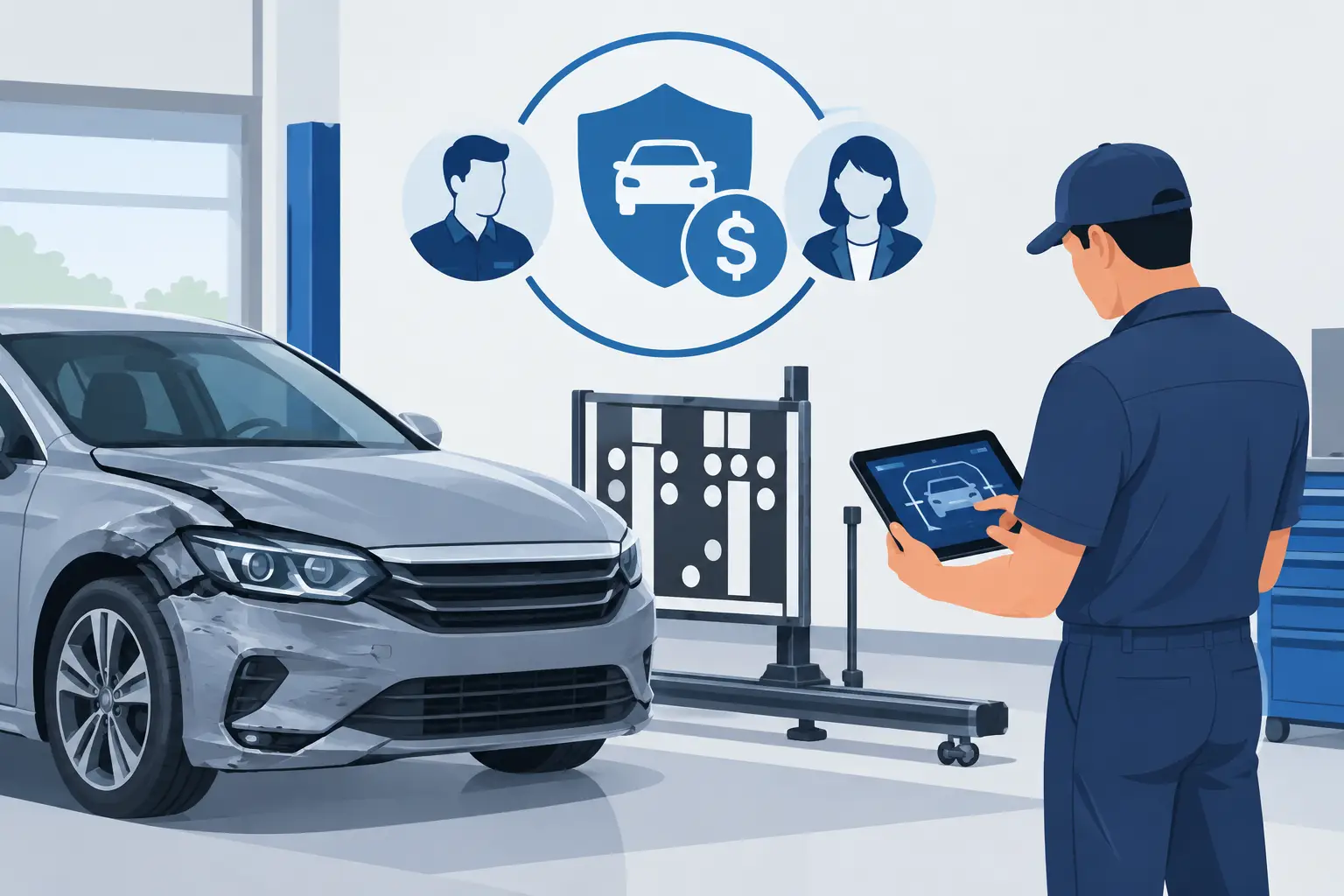
A vehicle arrives with bumper damage, a cracked windshield, or a minor front-end impact. The estimate appears straightforward until the repair plan identifies an ADAS calibration requirement. At that point, who pays calibrations becomes more than an estimating question. It becomes a claims, liability, customer-communication, and margin-management issue.
For collision operators, the core answer is simple: the party financially responsible for returning the vehicle to its pre-loss condition should pay for necessary calibration procedures. In an insured loss, that is generally the insurer under the applicable policy and claim terms. But the operational reality is more complicated. The repairer must establish that the calibration is required, document the basis for the operation, obtain authorization where needed, and ensure the procedure is completed correctly.
Who Pays Calibrations in an Insurance Repair?
When a calibration is required because of collision damage or because a repair operation affects an ADAS component, the cost should ordinarily be included in the claim. That may include static, dynamic, or dual calibrations; diagnostic scans; aiming procedures; wheel alignments needed to support calibration; and sublet charges from a qualified calibration provider or dealership.
The determining factor is not whether a sensor visibly broke. Many OEM procedures require calibration after repairs involving bumper covers, windshields, mirrors, radar brackets, suspension, steering, four-wheel alignment, module replacement, battery disconnect procedures, or structural work near sensor mounting locations. The repair requirement comes from the vehicle manufacturer’s procedures and the condition of the specific vehicle, not from an adjuster’s assumption that a low-speed loss could not affect ADAS performance.
Insurers may review the operation for causation, necessity, price, and documentation. That is a legitimate claims function. A repairer, however, should not treat an insurer’s initial omission of calibration on an estimate as proof that the operation is unnecessary. The repair plan needs to identify the applicable procedure, explain the triggering repair or condition, and carry an invoice or internal record showing the work was performed.
The best-supported file connects four points: the loss, the OEM procedure, the required preconditions, and the completed calibration result. That evidence reduces the chance that a calibration is framed as a discretionary shop process rather than a necessary repair operation.
The Customer Is Not Automatically the Fallback Payer
A common breakdown occurs when the insurer has not yet approved a calibration and the vehicle is nearing delivery. Some facilities ask the customer to pay first, with the expectation that reimbursement can be sorted out later. That approach creates unnecessary risk unless the customer clearly understands the charge, the reason for it, and any uncertainty around insurer payment.
The customer is ultimately responsible for charges not covered by insurance under the repair authorization. But that does not mean the customer should absorb a documented, collision-related safety procedure merely because the carrier disputes it or the supplement approval is delayed. Repairers should avoid presenting the issue as a choice between paying out of pocket and taking delivery with an incomplete repair.
If coverage is genuinely unresolved, the facility needs a defined escalation path. That may involve submitting the OEM procedure and sublet invoice, requesting a reinspect, elevating the file through a carrier repair-program contact, or explaining the position directly to the vehicle owner. The customer should receive a clear distinction between a deductible, a non-loss-related maintenance issue, and a required repair operation under dispute.
This distinction matters commercially. Poor communication can turn a valid calibration charge into a customer-experience failure, while a shop that silently absorbs repeated denials can erode gross profit across an entire DRP or insurer segment.
Causation Changes the Payment Discussion
Not every calibration performed during a repair belongs on the collision claim. The question is whether the loss or the collision-related repair created the requirement.
Consider a vehicle that arrives with multiple dashboard warnings, prior damage, an altered suspension, aftermarket equipment, or a failed camera unrelated to the reported loss. The shop may still need diagnostic work to establish a safe repair path, but the carrier may have a defensible basis to deny portions of the work that are unrelated to the accident. Similarly, if a pre-existing ADAS fault prevents successful calibration, resolving that fault may be the owner’s responsibility.
That is why pre-repair scanning and condition documentation are financially significant. A scan can identify diagnostic trouble codes before disassembly. Photos can capture prior damage, warning lamps, aftermarket modifications, tire condition, ride-height issues, and windshield defects. These records do not eliminate disagreement, but they give the repairer a factual basis to separate collision causation from pre-existing conditions.
Repair facilities should also be careful with blanket assumptions. A calibration may be required after a windshield replacement even when the glass loss is handled under a separate comprehensive claim. A mechanical shop performing alignment or steering repairs may trigger an ADAS procedure that the customer, warranty administrator, or service contract provider must address. The payer follows the responsible transaction, not the department performing the work.
Estimating for Calibration Without Giving Away the Margin
Calibration pricing is often treated as a single sublet line, but the operational cost extends beyond the provider invoice. A safe and compliant process can involve researching OEM procedures, performing pre- and post-repair scans, transporting the vehicle, preparing the vehicle for calibration, verifying targets or environmental requirements, completing an alignment, reviewing results, and retaining documentation.
Whether those supporting tasks are separately billable depends on the insurer agreement, estimating platform, applicable labor rules, shop policies, and the actual work performed. The critical discipline is to distinguish between the calibration vendor’s charge and the repair facility’s own labor and administrative steps. A sublet invoice alone may not reflect the full cost of managing the operation.
For multi-shop operators, this is a process-control issue as much as an estimating issue. Different estimators can produce materially different outcomes if one identifies calibration triggers at blueprinting while another waits until final quality control. Late discovery creates delivery delays, rushed approvals, rental extensions, and avoidable friction with both insurers and customers.
A standardized calibration workflow should define who researches procedures, when scans are run, when a calibration partner is scheduled, what documentation must return to the file, and who verifies completion before delivery. Shops that outsource calibration still own the repair decision and quality outcome. The sublet relationship does not transfer that responsibility.
Insurer Networks and Direct Repair Agreements
DRP participation can complicate the conversation because repairers may feel pressure to meet cycle-time or severity targets while navigating a carrier’s preferred calibration process. The practical question is not whether a network has a preferred provider. It is whether the provider can perform the required OEM-informed procedure, within the necessary timeframe, with complete results documentation.
Preferred vendor arrangements can create efficiency when scheduling, pricing, invoicing, and data transfer are well organized. They can also introduce risk if a shop is pushed toward a one-size-fits-all approach that does not account for vehicle-specific repair procedures or local capacity constraints.
Operators should review DRP terms carefully for provisions related to diagnostics, calibration sourcing, sublet markup, documentation, invoice requirements, and dispute resolution. A network commitment should not override the facility’s obligation to repair the vehicle safely and according to applicable procedures. At the same time, repairers need cost discipline. Sending every vehicle for unnecessary work weakens credibility and makes justified operations harder to defend.
Documentation Is the Strongest Payment Tool
The most productive calibration conversations happen before the vehicle is reassembled, not after the customer is called for pickup. The repair file should make the operation understandable to someone who was not present in the shop.
For a disputed calibration, the file should ordinarily contain the OEM procedure or relevant excerpt, the estimate and repair plan, scan reports where applicable, photos of the affected area or component, alignment results when required, the calibration invoice, and the final completion report. Notes should state why the operation was needed and whether any pre-existing condition affected the outcome.
That level of documentation serves more than reimbursement. It supports quality control, protects the business in the event of a post-repair concern, and helps management identify recurring denial patterns by carrier, vehicle make, location, or estimator. Over time, that data can inform insurer negotiations, vendor selection, training priorities, and pricing strategy.
Calibration costs will continue to rise as ADAS content expands across more vehicle segments and more repairs trigger manufacturer procedures. The strongest position for a repairer is not to argue that calibrations are expensive. It is to show, vehicle by vehicle, why the operation was required, what it cost, and why releasing the vehicle without it was not an acceptable option.