










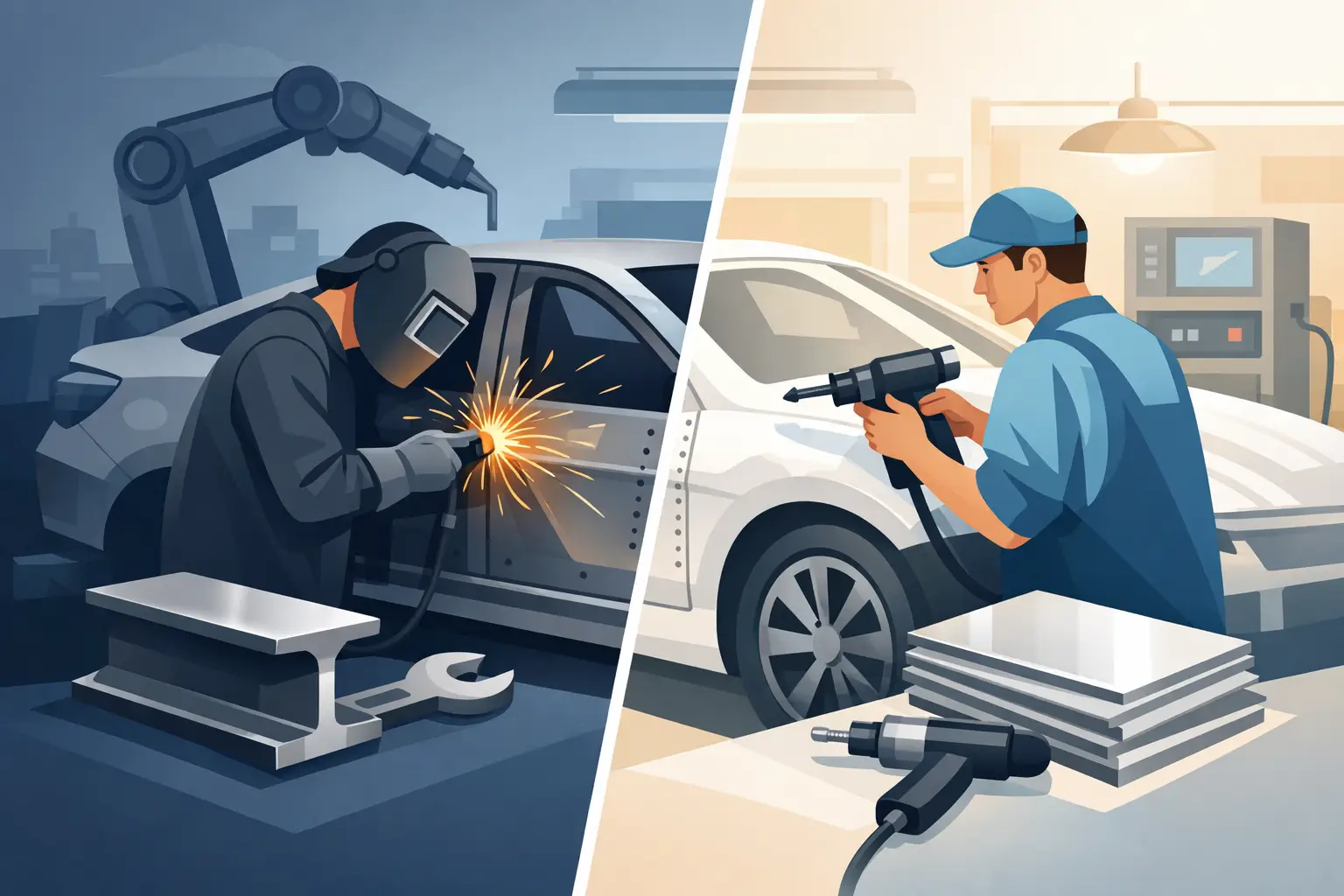
A late-model pickup with a damaged aluminum bedside can look like a straightforward panel repair until it reaches production. Segregated work areas, dedicated tools, cleaning protocols, joining requirements, and technician availability can quickly turn a small estimate line into a scheduling decision. Steel versus aluminum repair is therefore not simply a material comparison. For collision operators, it is a capacity, compliance, and margin-management issue.
The material mix entering a facility is becoming more complicated as automakers pursue weight reduction, electric-vehicle range, corrosion performance, and crash-energy management. Many vehicles combine conventional steels, advanced high-strength steel, aluminum, adhesives, rivets, and composite components within the same repair. A shop that treats aluminum as an occasional specialty job without defining its operating model may face avoidable delays, rework exposure, and sublet leakage.
Steel Versus Aluminum Repair Starts With Process Control
Steel remains the more familiar material for most collision facilities. Technicians have broad experience with steel panel straightening, sectioning, welding, corrosion protection, and refinishing. Equipment is widely available, replacement panels are generally supported by established supply channels, and the labor model is understood by estimators, production managers, and insurers.
That familiarity should not be confused with simplicity. Advanced high-strength steel and ultra-high-strength steel can impose strict limits on heat application, pulling methods, sectioning locations, and weld procedures. A repairable conventional-steel panel does not mean an adjacent structural member can be repaired using legacy techniques. OEM repair procedures, not material labels alone, determine whether a component can be repaired, sectioned, or must be replaced.
Aluminum adds another layer of operating discipline. The core issue is contamination. Steel dust and particles can embed in aluminum and create corrosion concerns, while cross-use of tools can compromise repair quality. Aluminum repair requires dedicated tools and consumables, controlled cleaning practices, and, in many cases, an isolated work area. The goal is not necessarily to build a separate aluminum department for every facility. It is to establish a repeatable process that matches the volume and complexity of the work being accepted.
Joining methods are also different. Steel repair may rely on resistance spot welding, MIG brazing, MIG welding, or approved mechanical fastening, depending on the substrate and OEM procedure. Aluminum structures often require self-piercing rivets, flow-drill screws, structural adhesives, aluminum-capable welders, or a combination of these methods. Each method carries equipment, training, cycle-time, and quality-control implications.
The Labor Equation Is Larger Than Body Hours
Estimating systems can identify operations, but the estimate alone does not define the real production burden. Aluminum repairs often require additional setup, teardown, isolation, cleaning, tool changes, and verification steps that can interrupt flow if a shop has not planned for them. The constraint may be a certified technician, an available aluminum bay, a rivet gun, a required adhesive cure window, or parts that must be confirmed before structural work begins.
For multi-shop operators, the key question is whether aluminum capability should be distributed or centralized. A high-volume market with substantial aluminum-intensive vehicle population may justify equipping multiple locations. In a lower-volume market, a hub-and-spoke model can protect capital and concentrate technician proficiency, provided towing, customer communication, insurer alignment, and transfer timing are tightly managed.
Centralization has trade-offs. Moving a vehicle between locations can add days, handling risk, and administrative friction. It can also improve repair quality and reduce rework when the receiving facility has stronger tooling, better-trained technicians, and a mature quality-control process. The right decision depends on local car parc, OEM certification commitments, referral patterns, severity mix, and the cost of lost capacity at the originating location.
Technician development is equally material. Sending one technician to an aluminum course does not create a durable repair capability if that person rarely performs the work or lacks support from estimators and production staff. Training needs to extend from repair planning through final quality inspection. Estimators must recognize when procedures call for specialized operations. Parts teams must understand one-time-use fasteners and required hardware. Refinish teams need appropriate preparation practices for aluminum substrates and mixed-material repairs.
Claims Economics Require Earlier Decisions
Steel versus aluminum repair can affect severity before a technician begins metal work. Aluminum panels may carry higher replacement costs, while approved repair procedures may add rivets, adhesives, corrosion-protection materials, scan operations, calibrations, and non-included labor. Conversely, replacement is not automatically the most expensive path when a repair would consume extensive skilled labor, tie up a constrained bay, and create uncertainty about outcome.
This is where disciplined repair planning matters. A complete teardown, documented OEM procedure review, and early parts validation give estimators and insurers a clearer basis for authorizing a repair path. Delayed discovery of aluminum-specific requirements can produce supplements after the production plan has already been set, putting pressure on promised dates and gross profit.
Insurers are also evaluating consistency. A repair facility that documents material identification, required operations, and adherence to OEM procedures is better positioned to explain why a claim requires specialized labor or equipment. The conversation should be framed around vehicle-specific repairability and safe completion, not a generic assertion that aluminum costs more.
For operators, the financial discipline is straightforward: measure the work. Track aluminum repair hours, setup time, sublet expense, parts delays, touch time, cycle time, supplement frequency, and gross profit separately from the broader book of business. Without that visibility, management cannot determine whether its aluminum program is generating a return, consuming capacity, or sending profitable work elsewhere.
Facility Investment Should Follow Vehicle Mix
The most common investment mistake is buying equipment without defining the workflow around it. A dedicated aluminum repair station, dust extraction, dent repair tools, joining equipment, and segregated consumables can be appropriate investments. But the business case depends on annual repair volume, local vehicle population, OEM program requirements, available technical labor, and whether the facility can protect the space from becoming general overflow.
A practical capability plan should account for four connected elements:
- Material identification and OEM procedure access before repair planning is finalized.
- Segregated workspace, dedicated tools, and cleaning controls that prevent cross-contamination.
- Technician, estimator, and production training tied to the actual vehicle mix being repaired.
- Performance reporting that identifies whether the process improves throughput and margin.
Not every shop needs every level of aluminum capability. Cosmetic aluminum panel work is different from structural repair on an aluminum-intensive vehicle. Some facilities may be well served by repairing limited damage and replacing more complex structures. Others may need a full capability because fleet, dealership, or certification relationships make the investment strategically necessary.
The same logic applies to steel. A shop with strong conventional metal capability can still be exposed if it lacks the equipment and procedures for advanced high-strength steel. Material-specific repair planning should be treated as a core production discipline, not as a specialty exception reserved for aluminum jobs.
Repair Quality Depends on the Entire Handoff Chain
The technical repair is only one point in the process. Parts procurement, blueprinting, structural measurement, scans, calibration planning, corrosion protection, refinish, and quality control all influence whether a mixed-material repair leaves the shop complete. A missing rivet, delayed adhesive, incorrect replacement part, or overlooked calibration can stall a vehicle after the body repair is effectively finished.
Production leaders should build material checkpoints into the daily repair-plan review. Is the material confirmed? Are required procedures saved to the file? Are all fasteners and consumables on order? Is the qualified technician scheduled? Does the refinish team know the substrate and repair method? These questions are operationally basic, but they prevent the kind of late-stage surprises that inflate length of rental and weaken customer confidence.
There is also a market-positioning dimension. As vehicle construction grows more varied, repair networks that can demonstrate reliable mixed-material capability will be more attractive to referral partners, dealerships, fleets, and insurers. Capability claims should be supported by process evidence, training records, equipment readiness, and measurable outcomes rather than marketing language alone.
The productive next step for a collision operator is not to declare steel or aluminum inherently better for business. It is to review the last several months of material-specific repairs, identify where time and money were lost, and decide whether the answer is better planning, deeper training, a targeted equipment purchase, or a referral relationship that protects repair quality.