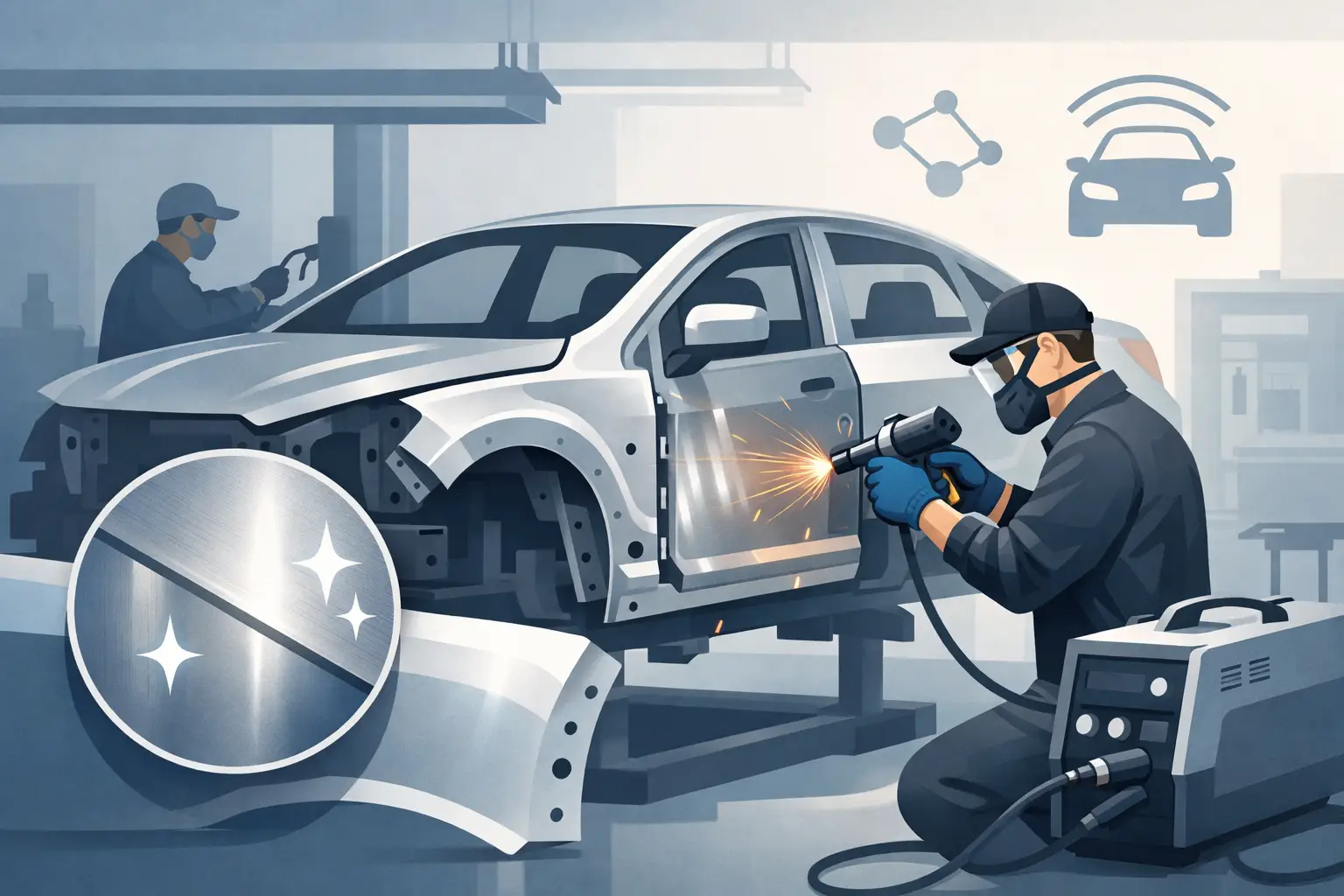
A guide to aluminum body repair is no longer a niche reference for facilities pursuing luxury-brand work. Aluminum-intensive pickups, EVs, SUVs, and mixed-material platforms have made material-specific repair capability a capacity, liability, and margin issue for collision operators. The repair decision starts well before a technician picks up a dent puller or welder: it begins with identifying the substrate, isolating the work area, following OEM procedures, and setting an estimate that reflects the actual labor and equipment required.
For MSOs and independent shops alike, the central question is not whether aluminum can be repaired. It often can. The operational question is whether the shop has the controlled process, trained staff, tooling, documentation, and insurer alignment to repair it correctly and profitably.
Why Aluminum Changes the Repair Operation
Aluminum is lighter than steel and has become a strategic material in vehicle lightweighting. But its physical behavior changes the repair process. It dissipates heat quickly, has different springback characteristics, work-hardens readily, and can lose strength when improperly heated. A repair approach that appears routine on mild steel can create cosmetic, structural, or corrosion-related problems on an aluminum panel.
Cross-contamination is the immediate shop-floor concern. Steel dust and particles embedded in aluminum can lead to galvanic corrosion, particularly where coatings are compromised. That is why OEM-oriented aluminum repair programs generally require a dedicated aluminum repair area, separate tools and consumables, and disciplined cleanup practices. A rolling aluminum repair bay can work for a lower-volume operation, but only if it creates meaningful separation from steel grinding, sanding, and welding activity.
The business impact is broader than the repair stall. Aluminum work can affect blueprint time, parts decisions, cycle time, refinish sequencing, sublet exposure, technician scheduling, and final quality-control steps. Shops that treat it as a simple material substitution frequently underestimate labor and absorb preventable cost.
Guide to Aluminum Body Repair: Start With Repair Planning
The first repairable question is not how to straighten the panel. It is whether the vehicle manufacturer permits the proposed repair method for that specific component, damage location, and model year. OEM repair information should define the process, including whether a panel can be cold-repaired, heat-straightened within a stated temperature range, sectioned, bonded, riveted, welded, or replaced.
A reliable repair plan starts with material identification. Many vehicles combine aluminum closures, steel reinforcements, ultra-high-strength steel structures, magnesium components, composites, and adhesives within the same repair zone. Visual inspection is not enough. Technicians and estimators need OEM documentation, vehicle identification data, and, where appropriate, approved material-testing methods.
Damage assessment should also account for hidden distortion. Aluminum panels may show less obvious surface evidence while retaining stress or deformation around attachment points, inner structures, hinges, lamp pockets, and sensor mounts. On late-model vehicles, a repairable hood, fender, liftgate, or quarter panel may sit next to systems that require scanning or calibration after removal, replacement, or alignment work.
The estimate should reflect this sequence. Research time, setup, dedicated-area preparation, corrosion protection, R&I, one-time-use fasteners, adhesives, rivets, welding operations, scanning, calibration verification, and refinish materials are not optional administrative details. They are part of returning the vehicle to its documented repair standard.
Repair Versus Replace Is a Technical and Financial Decision
Replacement is not automatically the safest option, and repair is not automatically the most profitable one. The right call depends on the OEM procedure, extent and location of damage, panel access, technician capability, parts availability, and the effect on downstream operations.
A repair can preserve cycle time when replacement parts are constrained, particularly for high-volume truck and SUV segments. Yet a repair that demands multiple metal-finishing operations, extended refinish work, or uncertain quality may consume more capacity than replacement. Conversely, a replacement can introduce significant R&I, fit-up, corrosion-protection, and calibration requirements that are missed in an early estimate.
Operations leaders should review repair-versus-replace outcomes by model, panel type, severity, technician, and payer. That data can expose recurring estimating gaps and identify where a shop’s actual process differs from its intended process.
Build a Controlled Aluminum Work Area
A dedicated aluminum repair environment does not need to be elaborate, but it must be functional. The objective is to prevent ferrous contamination and allow technicians to complete repair procedures without borrowing steel-area equipment or improvising around space constraints.
At minimum, the area should have dedicated hand tools, dent-pulling equipment, abrasives, files, sanding blocks, extraction capability, and clearly identified storage. Aluminum-specific welders, rivet guns, self-piercing rivet systems, adhesive dispensing equipment, and resistance spot-welding equipment may be required depending on the vehicle mix and OEM certifications the facility supports.
Tool discipline matters as much as the capital purchase. A designated hammer that migrates to a steel repair stall undermines the process. The same applies to grinders, wire brushes, sanding discs, and vacuum accessories. Clearly marked carts, shadow boards, consumable controls, and end-of-job cleanup procedures reduce reliance on memory during a busy production day.
Ventilation and dust extraction require attention as well. Fine aluminum dust presents both contamination and housekeeping concerns. Facility leaders should evaluate their extraction approach against equipment manufacturer guidance, applicable fire-safety requirements, and the repair tasks actually being performed. A space that looks dedicated but allows dust migration is not a controlled environment.
Heat, Pulling, and Joining Require Procedure Discipline
Aluminum’s heat sensitivity is one reason technicians cannot rely on familiar steel repair habits. Excessive heat can alter panel properties, damage adjacent adhesives or sealers, distort the panel, and create refinish complications. When an OEM permits heat use, technicians should use the prescribed temperature-control method rather than relying on visual judgment.
Cold repair techniques, controlled induction heating where approved, specialized aluminum dent pulling, and careful metal finishing may be appropriate. The permitted process varies by vehicle and panel. A shop should not generalize from a successful repair on one aluminum hood to a different structural or closure component on another platform.
Joining methods deserve the same caution. Modern vehicle construction may call for combinations of adhesive bonding, self-piercing rivets, flow-drill screws, MIG brazing, resistance spot welding, or manufacturer-specific fastening systems. The presence of aluminum does not itself dictate one joining method. The OEM procedure does.
Before welding or fastening, technicians need to identify adjacent materials, remove or protect components as directed, prepare mating surfaces correctly, and restore corrosion protection. Improper surface prep can compromise bond performance. Incorrect rivet selection, squeeze force, or fastener spacing can create a repair that appears acceptable externally but does not meet the engineered joint design.
Refinish and Corrosion Protection Are Part of the Repair
Aluminum does not rust in the same way as bare steel, but it remains vulnerable to corrosion, particularly where aluminum contacts dissimilar metals in the presence of moisture and damaged coatings. Refinish and corrosion-protection steps must follow the vehicle maker’s procedure and the coating supplier’s product guidance.
This is especially relevant around hems, seams, fastener locations, bonded flanges, and repaired edges. Technicians need to restore seam sealers, cavity protection, primers, and isolation materials where specified. A panel that looks correct at delivery can still become a comeback if corrosion protection or coating compatibility was overlooked.
Refinish managers should also plan for the practical behavior of aluminum panels in the booth. Panel temperature, substrate preparation, repair size, and adjacent blend requirements affect material use and booth scheduling. Tight coordination between body and paint departments prevents a repaired panel from reaching refinish before required corrosion-protection stages have cured or been documented.
Diagnostics, Calibration, and Quality Control
Aluminum body repair is often associated with panels, but its operational risk extends to vehicle electronics. Removal or replacement of bumpers, grilles, mirrors, windshields, suspension components, lamps, liftgates, and front-end structures can affect ADAS sensors and camera alignment. Pre-repair and post-repair scans should be planned from the start, not added when a warning light appears near delivery.
Calibration requirements depend on the OEM procedure and the repair performed. Static or dynamic calibration may be required after component replacement, wheel alignment, suspension work, or changes to sensor mounting geometry. The shop must decide whether to perform this work in-house or through a qualified partner, then account for scheduling, documentation, and quality verification.
A strong final inspection includes more than panel appearance and paint match. It confirms fastener and joint completion, restored sealers and coatings, water-management features, electronic functions, diagnostic results, calibration records, and repair-plan adherence. For network operators, standardized file documentation also supports insurer discussions, customer communication, and audit readiness.
Make Capability Decisions With Real Production Data
Not every collision center needs full aluminum certification coverage for every brand. The investment case depends on local vehicle parc, DRP and insurer mix, dealership relationships, repairable volume, technician depth, available floor space, and the cost of subletting or referring work.
A facility with occasional aluminum closures may need a disciplined basic capability and a defined escalation path for structural work. A shop serving aluminum-intensive pickups, premium vehicles, or EV-heavy markets may justify dedicated equipment, formal OEM training, and additional production controls. Neither model is inherently better. The risk comes from accepting work beyond the facility’s documented capability.
Track aluminum repair frequency, labor hours sold versus produced, parts replacement rates, sublet spend, cycle time, supplement causes, and quality outcomes. Those measures turn a tool-and-training decision into an operating decision. They also give estimators and managers evidence when explaining legitimate procedure-driven costs to payers.
The shops best positioned for aluminum volume will not be the ones with the most equipment on display. They will be the ones that can show a repeatable repair plan, a clean and controlled process, complete documentation, and a clear answer when a vehicle requires work outside their capability.