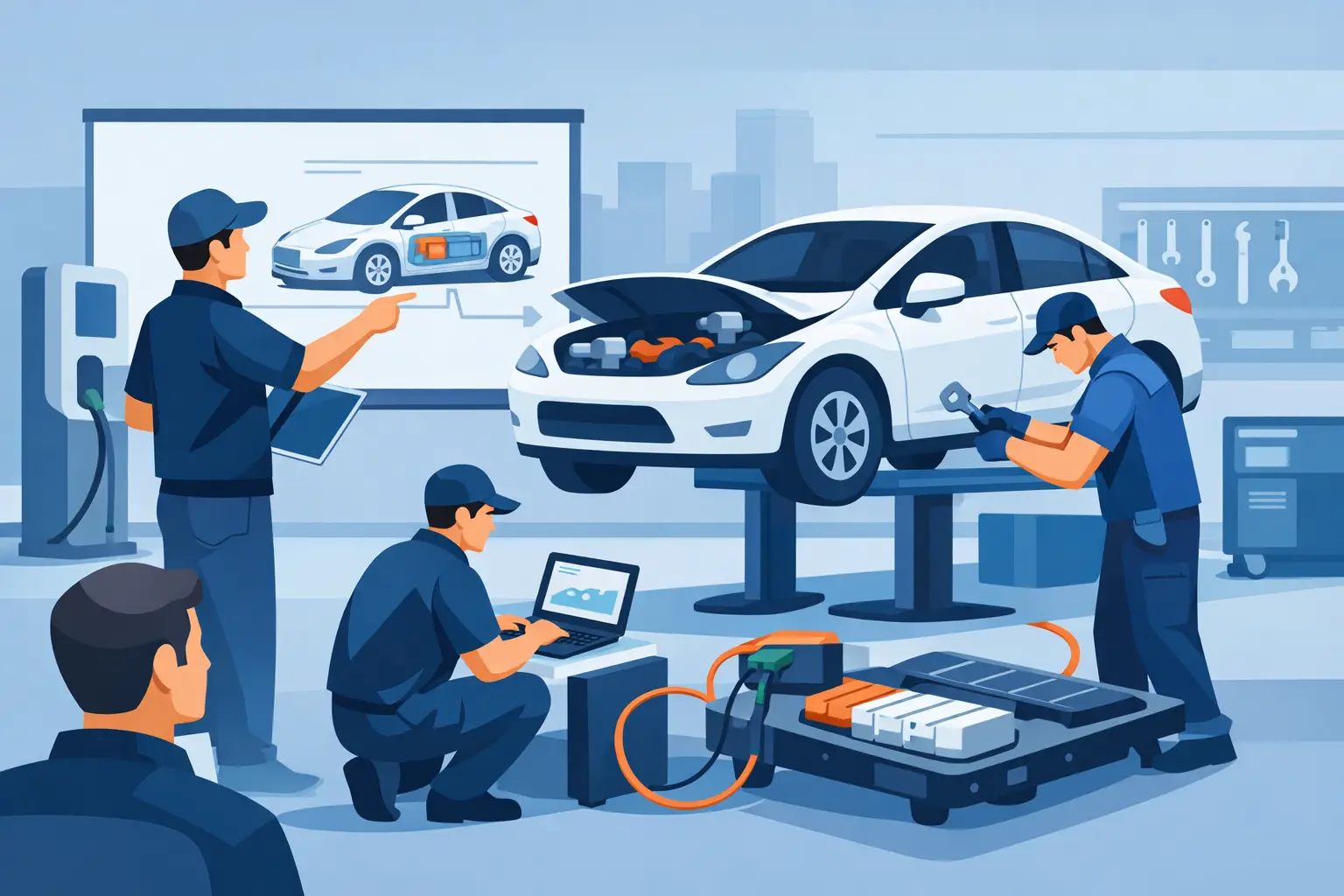
A high-voltage vehicle on a production floor is not simply another repair order with a different powertrain. It changes who can touch the vehicle, when it can move, how it is estimated, which tools are required, and where liability sits if a procedure is missed. For operators asking how to train EV technicians, the real objective is not to create a small group of EV specialists. It is to build a controlled operating model that keeps work flowing while protecting technicians, customers, insurers, and the business.
EV volume remains uneven across North America, and the training investment should reflect each market’s vehicle parc, OEM mix, repair mix, and referral patterns. But waiting until EVs represent a large share of monthly car count can be costly. A shop that lacks qualified personnel and documented procedures may have to decline profitable work, extend cycle time, or absorb sublet expense just as its local competitors build capability.
How to train EV technicians around actual job roles
The most common planning error is treating EV training as a single course assigned to every technician. High-voltage safety education is foundational, but it does not make a technician qualified to diagnose a battery thermal-management fault, isolate a damaged pack, or return a collision vehicle to service. Training must be tied to the tasks employees will perform and the authority they will hold.
Start with a role map. Service advisors, estimators, porters, tow partners, mechanical technicians, collision technicians, diagnostic specialists, and managers all need different levels of awareness and access. A front-office employee may need to recognize a damaged EV arriving after a collision and trigger the shop’s intake protocol. A technician working near orange high-voltage cabling needs a higher level of safety knowledge. The employee authorized to de-energize a vehicle, verify absence of voltage, or perform insulation testing requires the most rigorous OEM-specific preparation.
A practical program should establish at least five competency tiers:
- General awareness for employees who receive, move, estimate, wash, or otherwise encounter electrified vehicles.
- High-voltage hazard awareness for technicians working adjacent to EV systems or performing routine service.
- Qualified technician status for personnel authorized to depower and secure a vehicle under approved procedures.
- Diagnostic and repair authorization for personnel handling high-voltage diagnosis, battery-related service, and post-repair verification.
- Incident-response leadership for managers or designated technicians who direct damaged-vehicle isolation, thermal-event response, and escalation.
The labels can vary by organization, but the permissions cannot be vague. A training matrix should state which employees are permitted to move a vehicle, connect a scan tool, remove service disconnects, perform a power-down, access battery enclosures, and release the vehicle after repair. That matrix becomes an operational control, not an HR document filed after the course is complete.
Begin with safety systems, not product knowledge
EV instruction often starts with battery architecture and electric motor theory. Those topics matter, particularly for diagnostic staff, but the first business risk is uncontrolled exposure to high voltage and battery damage. Every location handling EVs needs a written process for intake, identification, isolation, storage, emergency escalation, and handoff between departments.
Technicians should understand that a vehicle can be powered down yet still present hazards. Capacitors require discharge time. Damaged components can compromise normal isolation assumptions. Flood exposure, severe underbody strikes, fire damage, and undeployed restraint systems can change the risk profile. The shop should train employees to stop work when a condition falls outside the procedure rather than rewarding improvised problem-solving.
That requires investment beyond classroom instruction. Facilities need clearly marked isolation areas, appropriate barricades and signage, high-voltage personal protective equipment, insulated tools where required, lockout-tagout controls, and a process for inspecting and replacing safety equipment. Managers should also define who contacts the OEM, battery specialist, emergency services, insurer, or vehicle owner when a vehicle presents a potential thermal event or has suspected battery intrusion.
The trade-off is clear. Building a fully equipped EV bay before local demand materializes can tie up capital. Yet relying on ad hoc floor space and loosely defined response procedures creates a far larger downside when a damaged vehicle arrives unexpectedly. For many independents and smaller MSOs, a designated isolation process and a limited number of qualified employees is a more defensible first step than attempting full battery repair capability immediately.
Use OEM procedures as the operating standard
Generic EV courses are useful for establishing common language, electrical fundamentals, and hazard recognition. They are not a replacement for OEM repair information. Depower sequences, lifting points, battery handling, coolant requirements, calibration steps, diagnostic routines, and repair-versus-replace criteria vary significantly by manufacturer and vehicle platform.
Training leaders should align course selection with the vehicles the business is likely to see. A dealership has an obvious OEM pathway. An independent mechanical operation or collision center should use registration data, customer mix, DRP assignments, and insurer volume to identify priority makes. In some markets, training deeply on two or three high-volume brands will produce better near-term return than broad but shallow coverage across every EV on the road.
This is particularly important in collision repair. A repair plan involving rocker-panel damage, a floor deformation, or an underbody impact may require high-voltage system checks even when the battery pack is not visibly breached. Estimators need enough procedural literacy to flag those operations early. Blueprinting staff and technicians need disciplined access to current repair information. Otherwise, the business risks missed operations, supplement friction, delayed parts decisions, and an avoidable quality exposure.
Build diagnostic capability before promising complex repairs
High-voltage repair capacity depends on more than a certified technician. It depends on scan coverage, service information, battery-support equipment, insulated test equipment, calibration capability, network access, and an escalation path when a fault exceeds internal expertise. Shops should assess the entire workflow before advertising EV service or accepting work that requires advanced battery intervention.
For mechanical service, the near-term opportunity may be routine EV-adjacent work: brakes, tires, suspension, HVAC, thermal systems, 12-volt batteries, ADAS calibrations, and electronic diagnostics. These jobs still require EV awareness because an incorrect lift, disconnected sensor, or improper scan process can create risk. They may also offer a more measured route to technician confidence than launching directly into pack removal or internal battery repair.
For collision operations, the gating issue may be repair planning and safe vehicle handling rather than a decision to rebuild packs in-house. Battery removal, storage, transportation, and replacement can involve expensive equipment and strict manufacturer requirements. In many cases, the right operating model is to train internal staff to identify the need, secure the vehicle, document the condition, and coordinate with an approved specialist or dealer partner.
That is not a capability gap if it is intentional. It is a managed make-versus-buy decision. The mistake is promising repair scope that the facility, tooling package, and technician authorization level cannot support.
Make training measurable on the shop floor
Course completions are easy to report and easy to overvalue. The better question is whether training changes repair execution. Supervisors should use observed task sign-offs, procedure audits, and case reviews to verify competence after employees return to production.
A technician who completed a high-voltage safety module should demonstrate the correct use of PPE, vehicle identification, service-disconnect procedures, verification steps, and documentation. A diagnostic technician should show proficiency using OEM information, interpreting fault data, following test plans, and documenting pre- and post-repair scans. For collision teams, quality-control reviews should confirm that battery-related inspections, restraints procedures, calibrations, and required scans were included in the repair file.
Track business measures as well. EV repair orders can reveal whether the program is improving or creating friction. Useful indicators include estimate-to-delivery cycle time, supplements tied to missed EV operations, sublet spend, technician utilization, training completion by role, repeat repairs, and safety incidents or near misses. Segmenting these results by make and repair type will help leadership decide whether to expand internal capability or strengthen external partnerships.
Protect technician retention while raising the bar
EV training can become a retention tool when it is connected to a visible career path. Technicians are more likely to invest in difficult technical education when the business recognizes advanced authorization with pay progression, lead responsibilities, diagnostic time, or access to higher-value work. Asking employees to carry greater safety and quality responsibility without changing compensation or workload expectations creates understandable resistance.
Managers also need to plan for production coverage. Pulling a key technician into multi-day training during peak season can worsen backlog and frustrate the rest of the team. Staggered cohorts, cross-training, paid study time, and scheduled skill verification can reduce disruption. Larger groups may centralize advanced EV work at selected hubs while providing baseline safety readiness across all locations.
The strongest EV workforce programs will not be measured by how many certificates hang in the break room. They will be measured by whether a shop can receive the vehicle, scope the work accurately, protect its people, follow the procedure, document the repair, and make a disciplined decision when the job belongs with a specialist. That is the capability customers, insurers, and referral partners will increasingly expect.