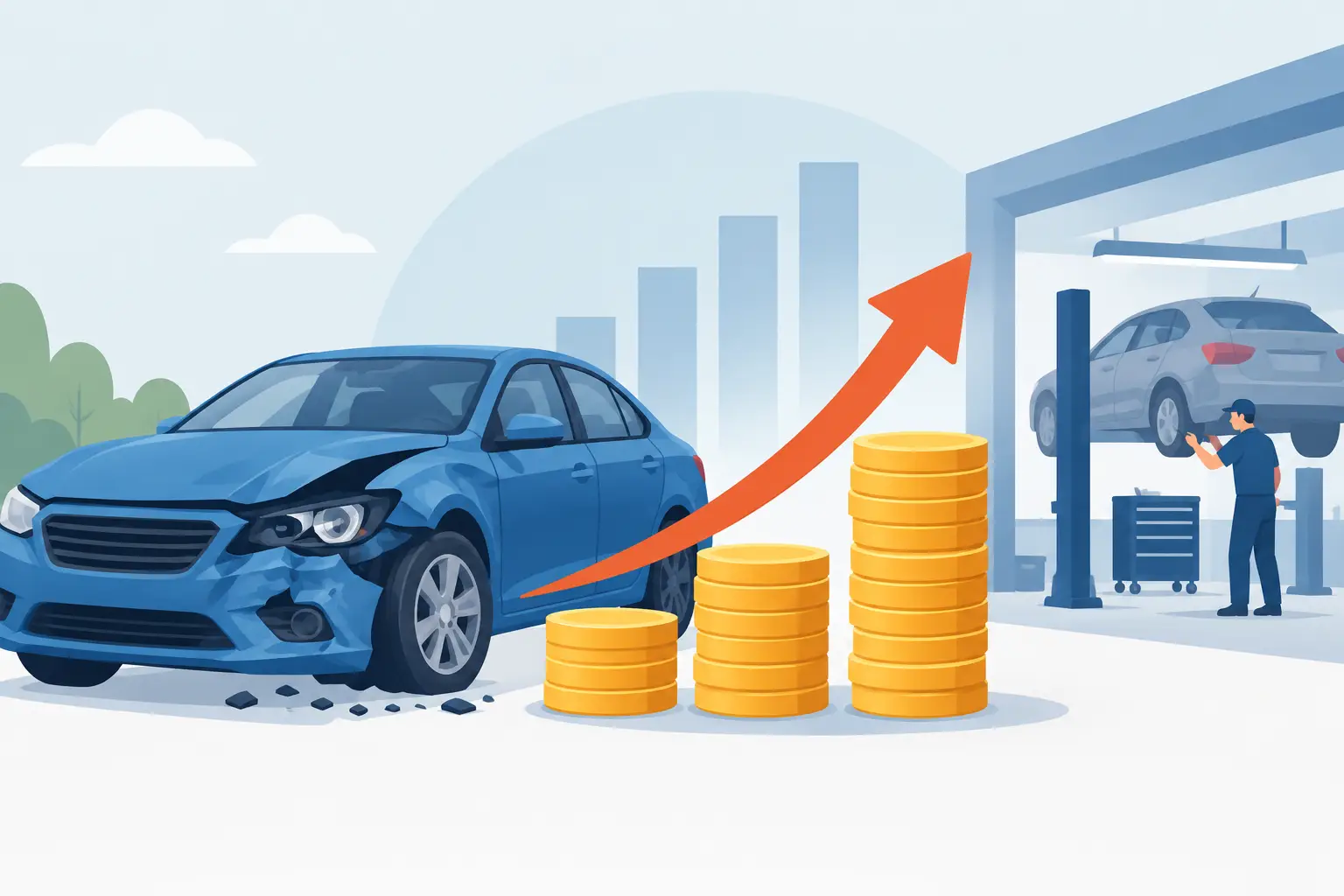
A $4,000 repair estimate can become a $7,000 file before a vehicle reaches the paint booth. That gap is the operating reality behind collision inflation: the sustained rise in claim severity driven not only by higher prices, but by more complex vehicles, longer repair processes, constrained capacity, and a claims ecosystem still adapting to both.
For collision operators, insurers, suppliers, and repair networks, the issue is not whether repair costs have risen. It is whether their estimating practices, labor models, parts strategies, customer communications, and capital plans have kept pace with the new cost structure. A higher average repair order can lift revenue, but it does not automatically improve margins or shop performance.
Claims Economics: What Is Driving Collision Inflation?
Collision inflation is often discussed as a parts-price problem. Parts matter, particularly in categories affected by OEM supply constraints, model-specific availability, freight costs, and rising vehicle values. But parts pricing is only one element in a broader severity equation.
The vehicle itself is the primary structural driver. Late-model vehicles carry more cameras, radar units, ultrasonic sensors, control modules, advanced lighting, battery-management components, and mixed-material construction than prior generations. A repair that once involved replacing a bumper cover may now require pre-repair scanning, aiming procedures, radar or camera calibration, an alignment, and documented post-repair verification. The visible damage may be modest while the required repair plan is not.
That distinction has material consequences for estimating and production. More operations are being identified after teardown, more repair steps are subject to OEM procedure requirements, and more work must be performed by outside calibration, glass, mechanical, or dealership partners. Each handoff introduces cost, scheduling exposure, and potential delay.
Labor is the second major pressure point. The industry continues to face shortages of experienced body technicians, painters, estimators, and diagnostic talent. Wage growth is a necessary response to that shortage, but it raises fixed and variable operating costs for shops that already must invest in training, retention, and productivity management. Labor-rate negotiations, meanwhile, do not always move at the pace required to cover the full cost of specialized repair capacity.
Material costs add another layer. Refinish products, shop supplies, energy, freight, hazardous-waste handling, and equipment maintenance have all become more significant operating considerations. Refinish inflation can be especially difficult to recover when reimbursement formulas do not reflect actual material consumption, product mix, or the cost of compliance with manufacturer specifications.
Higher Severity Does Not Equal Better Margin
For multi-shop operators and independent facilities alike, it is tempting to view rising repair severity as a revenue opportunity. The reality is more conditional. A shop can produce higher sales while seeing weaker gross profit, longer keys-to-keys times, and a more strained workforce.
The principal risk is that revenue rises faster than effective labor recovery. If a repair requires additional scanning, corrosion protection, setup, calibration coordination, administrative documentation, and quality-control steps, the shop must capture those operations consistently. Missing line items, delayed supplements, and incomplete documentation turn technical complexity into unrecovered cost.
Parts gross profit also deserves closer scrutiny. Higher OEM parts utilization may support repair quality and fit, but it can change gross-profit dollars and increase dependency on availability. Alternative parts may improve cycle time or affordability in some files, but appropriateness varies by vehicle age, insurer guidelines, customer expectations, and repairability. There is no universal parts strategy that optimizes every repair.
Cycle time remains the operational pressure valve. A vehicle waiting three days for a backordered lamp assembly, a calibration appointment, or insurer authorization occupies space without producing completed-repair revenue. As severity rises, capacity management becomes as important as estimating accuracy. Shops need visibility into work in process, parts status, sublet scheduling, technician loading, and bottlenecks by production department.
Collision Inflation Changes the Total-Loss Conversation
Rising repair costs also shift the repair-versus-total-loss threshold. When parts, labor, and required procedures push a repair closer to actual cash value, insurers may total vehicles that would have been repaired under a lower-cost environment. That has implications well beyond claims handling.
For repairers, more total losses can reduce available repair volume in some segments, especially older vehicles with lower valuations. For recyclers and salvage operations, it can increase the flow of repairable and parts-bearing inventory, although vehicle condition, title regulations, auction economics, and battery safety requirements determine whether that inventory is commercially useful.
The effect is not uniform across the car parc. High vehicle values can preserve repairability even as repair costs increase. Conversely, a relatively moderate collision on an older vehicle can become uneconomic when it includes airbag deployment, structural work, or ADAS component replacement. EVs add another variable: battery condition and high-voltage safety procedures can materially affect the repair decision even when the impact area appears unrelated to the battery pack.
Repairers should treat total-loss frequency as a local market and vehicle-mix metric, not merely a national headline. A market with older vehicles, high deductibles, limited specialty capacity, or a different mix of luxury and EV units will experience the trend differently.
The Estimating Discipline That Protects Recovery
The best response to collision inflation is not simply to write larger estimates. It is to build a repeatable process that identifies required operations early, supports them with evidence, and moves them through approval without avoidable friction.
A disciplined blueprinting process is central to that effort. Pre-repair scans, complete teardown where appropriate, OEM procedure research, structural and suspension inspection, and early identification of calibration needs can reduce downstream surprises. They will not eliminate supplements, particularly where concealed damage exists, but they improve the quality of the initial repair plan and give production teams a more reliable schedule.
Documentation matters because the repair file now serves multiple functions. It supports insurer negotiation, protects the facility in a liability-sensitive environment, informs technician instructions, and creates a record of completed procedures. Photos alone are often insufficient. The file may need procedure references, scan reports, calibration invoices, alignment results, parts invoices, and clear notes explaining why a non-included operation was necessary.
This requires estimators to operate closer to repair planners than traditional appraisers. The role increasingly combines technical interpretation, payer communication, customer expectation management, and production coordination. That shift should influence training budgets, compensation design, and staffing models.
Shop Metrics That Reveal the Pressure
Average repair order is useful, but it is not enough. Operators assessing the effect of collision inflation should monitor gross profit by labor category, billed versus paid hours, supplement frequency and aging, parts arrival performance, sublet turnaround, and touch time. They should also separate cycle-time delays caused by internal workflow from delays caused by parts, approvals, or outside providers.
That segmentation matters. A shop cannot manage a calibration bottleneck if it is buried inside a broad cycle-time average. Likewise, an insurer cannot assess repair-network performance fairly if all delays are attributed to the repair facility without regard to parts availability or approval timing.
Insurer-Repairer Alignment Is Becoming More Valuable
The collision industry has long managed tension between indemnity cost control and repairer cost recovery. Collision inflation makes that tension harder to ignore, because unsupported cost suppression can create downstream consequences: delayed repairs, repeated supplements, technician frustration, weaker network participation, and customer dissatisfaction.
Constructive alignment does not mean every requested operation should be accepted without review. It means the review process should be capable of evaluating modern repair requirements with speed and technical competence. Clear rules for scans, calibrations, OEM procedures, diagnostics, refinishing, and sublet work reduce unnecessary administrative churn.
Direct repair relationships remain valuable where they provide dependable volume, faster approvals, shared performance data, and a workable path for resolving technical disputes. But shops should evaluate those relationships through contribution margin and operational fit, not volume alone. A high-volume program that consumes estimator time, depresses recovery, or increases work-in-process exposure can weaken the business even while it fills bays.
Capital Planning Has Become a Repair-Quality Issue
Equipment investment is no longer limited to frame racks, welders, and paint booths. Facilities may need scan tools, secure access capabilities, calibration systems, alignment capacity, aluminum repair infrastructure, battery handling equipment, and upgraded documentation platforms. Whether to bring those capabilities in-house depends on local volume, technician competence, capital cost, available space, and the reliability of qualified sublet partners.
There is a real trade-off. In-house calibration can reduce handoffs and create scheduling control, but an underutilized system can become an expensive asset with limited return. Outsourcing can preserve capital and access specialists, but only if turnaround time and documentation quality are dependable. The right answer differs between a single-location independent and a regional MSO with concentrated repair volume.
Workforce investment follows the same logic. A shop cannot buy its way out of a technician shortage, but it can reduce avoidable friction through better repair planning, clearer dispatch, training pathways, pay structures tied to quality and productivity, and a work environment that does not ask technicians to solve preventable administrative problems.
Collision inflation will remain a defining claims-economics issue because the underlying vehicle technology is not becoming simpler. The operators that fare best will be the ones that translate complexity into documented, scheduled, recoverable work – and use the resulting data to make sharper decisions before margin pressure becomes a production crisis.