




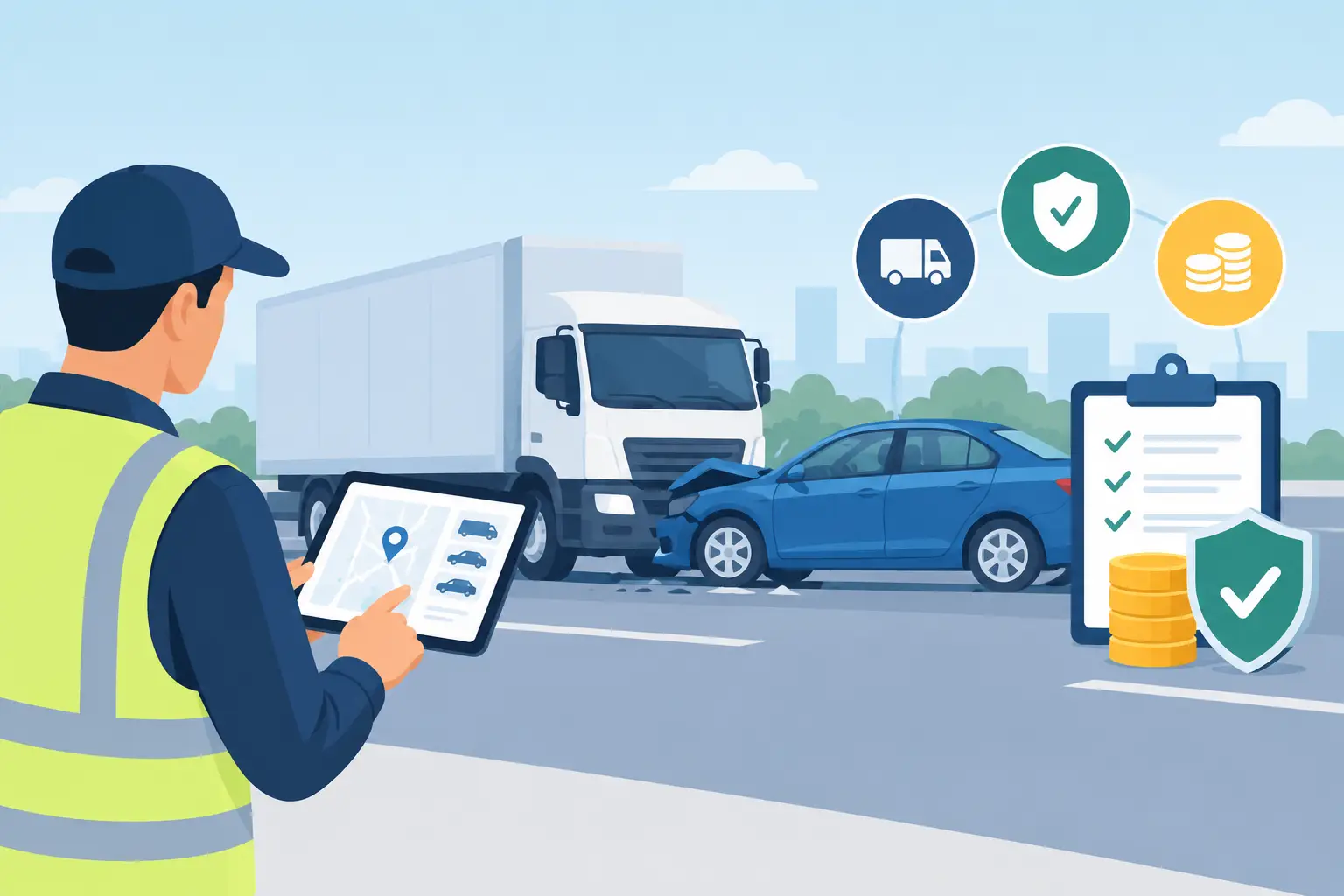
A disabled unit at 4:30 p.m. is not merely a safety incident. For a contractor, delivery operation, rental fleet, or dealer service fleet, it can become a missed route, an unplanned replacement vehicle, a claim file with incomplete facts, and a repair decision made before anyone has confirmed parts availability. A disciplined guide to fleet accident management starts with that operating reality: the goal is to return the asset to safe service at an acceptable total cost, while protecting the organization’s legal and claims position.
Fleet Accident Management Is a Margin Discipline
Accident management sits across fleet operations, safety, claims, procurement, maintenance, and collision repair. When those functions work from separate processes, cost leakage appears quickly. A driver may use an unapproved tow provider, an estimator may write a repair plan without fleet utilization data, and a claims administrator may pursue a total loss decision without accounting for replacement lead times or upfit value.
The direct repair estimate is only one component of accident cost. Fleet leaders should evaluate loss severity alongside downtime, substitute-vehicle cost, towing and storage, cargo disruption, injury exposure, administrative effort, depreciation, and the effect on insurance renewals. For a specialized vocational truck or a vehicle with a costly body upfit, a repair that looks uneconomic on a standard actual-cash-value calculation may deserve a more detailed business review.
That does not mean fleets should resist total-loss decisions. It means the decision needs complete inputs. Repairability, parts lead times, frame or structural damage, ADAS calibration requirements, battery condition, title rules, and the availability of a comparable replacement all affect the correct path.
Build the First 60 Minutes Around Facts and Safety
The first hour after a collision is where evidence is preserved or lost. Drivers need a concise, repeatable protocol that puts emergency care and scene safety first, then moves immediately to reporting and vehicle control. The procedure should be usable under stress, not buried in a 40-page policy manual.
Drivers should know who to call, how to identify the unit, which scene photos are required, when not to move a vehicle, and where a disabled asset may be towed. A mobile reporting form can speed this work, but only if the fleet has trained drivers on it and provides a backup for poor connectivity or a damaged phone.
The initial report should capture the driver’s account while it is fresh, third-party and witness information, police-report details when available, time and location, weather and road conditions, vehicle photos, and any indication of injury. If the vehicle has telematics, preserve the relevant event data under a documented retention process. Telematics can clarify speed, harsh braking, route position, and impact timing, but it should support a broader investigation rather than replace one.
For commercial fleets, escalation criteria must be explicit. A serious injury, suspected impairment, a fatality, a hazardous-materials exposure, major property damage, a media-sensitive event, or a vehicle requiring specialized recovery should trigger immediate involvement from designated safety, legal, and claims personnel. Managers should avoid directing drivers to speculate about fault or discuss settlement at the scene.
Control the Vehicle Before Storage Charges Escalate
Towing and storage are frequently treated as minor administrative details until invoices arrive. They should be managed as a controlled vendor process. A fleet needs preapproved towing coverage, after-hours contacts, rate expectations, storage-release authority, and clear procedures for retrieving personal property, cargo, tools, or proprietary equipment.
The right recovery provider depends on the asset. A light-duty service van, a loaded box truck, an EV, and a vehicle with an aerial lift do not present the same recovery risks. EV incidents require particular care when battery damage, thermal events, or isolation procedures are possible. Moving a damaged high-voltage vehicle to a facility that lacks appropriate containment or assessment capability can add delay and liability.
Once the vehicle is secured, the fleet should decide where it will be inspected. Insurer direct-repair arrangements can shorten cycle time, but fleets with specialized vehicles may need qualified commercial collision centers, truck-body shops, equipment upfitters, or OEM-capable diagnostic providers. The lowest labor rate is rarely the best selection criterion if it extends downtime or creates a post-repair quality problem.
Create a Repair Triage Process That Reflects the Asset
A strong fleet accident management guide separates routine claims from complex losses early. That triage should consider visible damage, drivability, likely structural work, airbag deployment, ADAS sensor and camera involvement, powertrain or battery concerns, cargo exposure, and whether the unit is mission-critical.
Repair planning needs more than a preliminary estimate. Collision centers should complete a thorough teardown where appropriate, identify OEM repair procedures, document required scans and calibrations, and provide a realistic parts and sublet plan. For fleets, the conversation should also include available production capacity, expected blueprint completion date, supplement risk, and the repair facility’s process for communicating delays.
This is especially relevant for late-model vans, pickups, and passenger vehicles with integrated safety systems. A bumper impact can involve radar brackets, camera alignment, blind-spot sensors, wheel alignment, and calibration verification. Skipping these steps may reduce an invoice in the short term while increasing safety exposure and comeback risk. Conversely, fleets should review invoices carefully enough to distinguish documented, necessary operations from poorly substantiated charges.
For medium- and heavy-duty equipment, parts availability and body or upfit complexity can dominate the repair cycle. Fleet maintenance managers should coordinate with the collision facility before authorizing repairs that affect mounted equipment, liftgates, refrigeration units, telematics hardware, or custom interior installations.
Align Claims Decisions With Operational Data
The claims workflow should establish a single owner for each file, even when the work is shared among an insurer, third-party administrator, broker, safety department, fleet manager, and repairer. Ambiguous ownership is a common source of stalled approvals, unreleased supplements, and vehicles sitting in storage.
A useful claim file ties financial data to operational facts. At minimum, teams should track:
- accident date, location, unit number, driver, and classification of loss
- tow, storage, appraisal, repair, rental, and substitute-asset costs
- estimate date, teardown date, authorization date, repair start, and delivery date
- parts delays, supplement causes, sublet requirements, and calibration activity
- days out of service and the business impact of unavailable capacity
- subrogation potential, recoveries, and final paid severity
These fields allow leaders to identify whether their largest problem is driver behavior, specific routes, particular vehicle configurations, repair-network capacity, slow approvals, or recurring parts constraints. A high average repair cost may be acceptable for a fleet with low downtime and complex equipment. A lower repair cost paired with excessive cycle time can be far more damaging.
Use Post-Loss Reviews to Improve Prevention
Accident management is not complete at vehicle delivery. The best fleets convert closed claims into specific prevention actions. That may mean targeted coaching for backing incidents, route changes at high-frequency locations, revised camera specifications, better cargo securement, or a change in vehicle assignment policy.
The review should be proportionate. A minor parking-lot scrape does not require the same investigation as a severe injury crash, but both can reveal patterns. Supervisors need access to trend reporting that is credible enough to guide action without encouraging underreporting. If drivers believe every incident will produce automatic punishment, the organization will receive late reports and weaker facts.
Leading indicators are often more useful than annual accident counts alone. Harsh-braking events, backing exposure, speeding exceptions, driver tenure, preventive-maintenance compliance, and near-miss reports can show risk before a paid claim closes. Still, data needs context. A driver operating dense urban routes will have a different exposure profile than one covering rural highway miles.
Technology investments should follow the fleet’s loss profile. Video telematics may materially improve disputed-liability handling and coaching for one operation, while another may gain more from centralized repair authorization, better driver reporting tools, or an expanded preferred-provider network. The business case should be measured against avoided downtime and loss severity, not just software subscription cost.
A fleet does not need a perfect incident to prove that its process works. It needs clear authority, timely facts, qualified repair partners, and enough data to make the next accident less disruptive than the last.