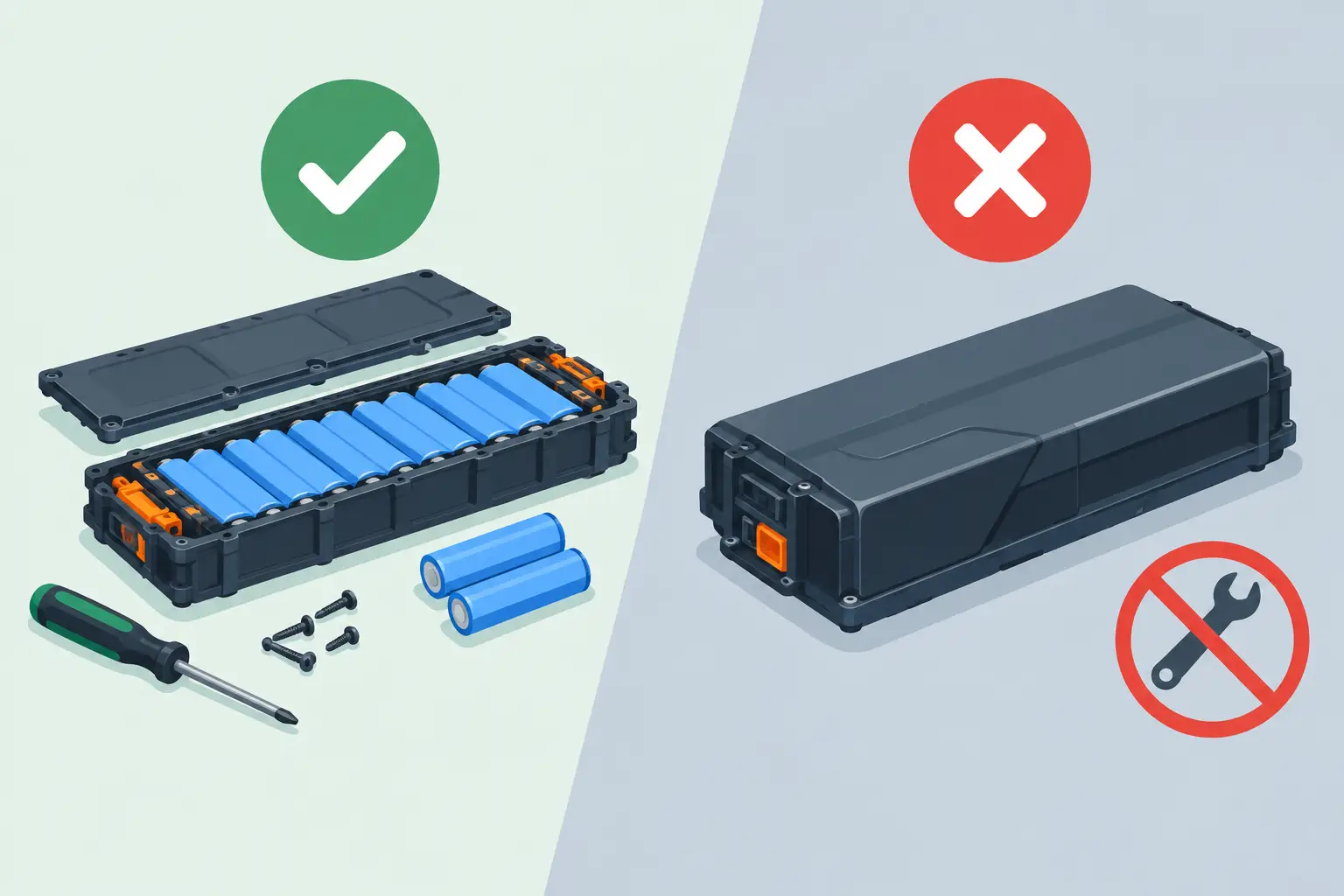
A battery pack can turn a repairable EV loss into a total-loss discussion before the estimate is complete. The distinction between repairable versus nonrepairable battery packs is no longer an engineering footnote for collision operators, insurers, and recyclers. It is becoming a direct driver of severity, cycle time, capital planning, and vehicle residual value.
The challenge is that “repairable” does not simply mean a technician can physically replace a damaged component. It means the vehicle manufacturer has provided a documented procedure, parts availability, diagnostic access, safety controls, and authorization path that allows the work to be performed and warranted. Where any of those elements is absent, a pack may be operationally nonrepairable even if the damage appears localized.
Why battery-pack architecture changes the repair decision
Most traction batteries are assemblies of cells, modules, busbars, cooling hardware, structural enclosures, sensing equipment, contactors, high-voltage junctions, and battery-management electronics. A strike to the underbody can affect more than the visible aluminum or composite shield. It can compromise sealing, thermal interfaces, electrical isolation, or a coolant circuit that is not readily accessible.
A repairable design typically allows approved replacement of selected modules, serviceable electronics, seals, cooling components, or enclosure sections. OEM procedures may define inspection thresholds, isolation tests, torque sequences, resealing requirements, and post-repair validation steps. This approach can prevent a full-pack replacement when diagnostic evidence supports a limited repair.
A nonrepairable pack is generally treated as a sealed, single replacement assembly after qualifying damage or fault conditions. That may reflect a manufacturer’s safety position, pack construction, certification requirements, lack of service parts, or concern that a field repair cannot restore the original level of water intrusion protection and crash performance. A pack can also be designated nonrepairable after thermal exposure, fire involvement, substantial deformation, or evidence of electrolyte leakage, regardless of whether it still powers the vehicle.
For estimators, the practical issue is not whether a damaged pack looks serviceable. The issue is whether its condition can be proven safe and returned to specification through an approved process.
Repairable versus nonrepairable battery packs: the claims economics
Full battery-pack replacement can be one of the highest-severity line items in an EV collision claim. It can move a late-model vehicle beyond the insurer’s repair threshold, especially when the estimate also includes suspension, structural, restraint-system, sensor, and refinishing work. The result is increased total-loss frequency and a greater need for accurate salvage handling.
Repairable packs create a different economic profile. Module-level or component-level service can lower the material cost, but it does not automatically produce a lower overall claim. High-voltage depowering, scan operations, insulation-resistance testing, battery lifting equipment, controlled work space, technician qualifications, and validation procedures add labor and administrative time. Parts lead times can also erase much of the theoretical cycle-time advantage.
The economic benefit is strongest when three conditions align: the damage is clearly limited, OEM-authorized service parts are available, and the repairer has an established process for completing the work without repeated sublets or diagnostic delays. When the process is improvised, a lower parts bill can be offset by supplements, extended keys-to-keys time, and avoidable liability.
Insurers face a related valuation problem. A vehicle with a repairable battery system may retain more economic value after a moderate underbody event than a comparable model requiring an entire pack replacement. Yet that advantage depends on repair-network capacity. A market with only a small number of qualified high-voltage facilities can still generate long tow distances, scheduling delays, and concentrated severity.
Documentation matters more than visual damage
Battery triage should begin before teardown decisions harden into an estimate. Shops need the OEM’s prescribed inspection procedure, not a generic assumption based on the location of an impact. The first questions are usually whether the high-voltage system can be safely de-energized, whether diagnostic trouble codes indicate isolation or thermal events, and whether the enclosure has signs of intrusion or deformation.
A disciplined file should capture pre-repair scans, fault codes, underbody images, pack measurements where permitted, visible leakage, coolant loss, and any evidence of fire or water exposure. That record supports repair planning, insurer communication, and later quality assurance. It also protects the shop when a vehicle arrives after a tow, secondary impact, flood exposure, or extended storage event with unclear history.
Visual inspection alone has limits. A battery enclosure can appear intact while internal components have been stressed, and a minor scrape can be acceptable on one vehicle but require replacement on another. Procedures, not appearance, establish the boundary.
Water intrusion and thermal events raise the stakes
Water exposure is particularly difficult because it may create corrosion or insulation issues that emerge after the initial inspection. Likewise, a pack involved in a thermal event may require a much more conservative disposition even if the vehicle is no longer actively smoking or displaying warnings.
Facilities need defined escalation paths for suspected thermal damage: isolation from buildings and other vehicles, observation protocols, emergency contacts, and coordination with the carrier and OEM guidance. These are operational controls, not optional add-ons. A battery-related incident can expose a business to property loss, worker-safety claims, and business interruption far beyond the value of the original repair order.
Capacity is now a network-management issue
Not every collision center should perform internal battery-pack repair. For many operators, the sound commercial decision is to build a reliable referral or sublet relationship with a certified EV center while retaining the surrounding collision work. The key is to understand who owns the diagnostic decision, transportation, pack handling, documentation, and final liability.
MSOs and insurer networks should map high-voltage capability more precisely than a simple “EV-ready” designation. Useful distinctions include facilities that can safely depower and assess a vehicle, those authorized for pack removal and replacement, and those approved for internal pack repair. These are materially different capabilities with different investments in training, tools, work bays, lifting systems, and safety infrastructure.
Technician development also remains a constraint. High-voltage work demands more than a one-time course. Teams need recurring competence in lockout procedures, personal protective equipment, safe lifting, contamination control, OEM information systems, and the documentation required to return a vehicle to service. Shop leaders should account for the productivity impact of sending technicians through training and the need to maintain coverage while those employees are out of the bay.
Parts, warranty, and salvage need to connect
The parts strategy for battery repairs is still evolving. Some manufacturers offer modules or selected service components, while others supply only complete assemblies. Availability can vary by vehicle generation, geography, and dealer support structure. Independent repairers must confirm part numbers and procedure applicability by VIN rather than assuming a solution used on one model carries to another.
Used battery components introduce additional complexity. State-of-health, provenance, compatibility, storage conditions, software pairing, warranty status, and transport rules can all affect whether a recycled component is viable. The lower acquisition cost may be attractive, but an unverified component can create repeat-repair exposure and disputes over warranty responsibility.
For recyclers, clearer identification of repairable and nonrepairable packs is equally consequential. A pack removed from a vehicle because of external collision damage may contain usable materials or serviceable components, but it must be evaluated and stored under appropriate safety controls. Facilities that can document condition, chain of custody, and tested component status will be better positioned as the secondary battery market matures.
What operators should measure now
Battery-related repairs are still a small share of many shops’ total volume, which makes them easy to treat as exceptions. That is precisely why they should be measured separately. Tracking pack-related supplements, parts lead time, days to authorization, sublet expense, total-loss conversion, tow costs, and reinspection rates will show where the process is breaking down.
Those data points also improve conversations with carriers and OEM programs. If a repairable procedure consistently reduces replacement cost but adds waiting time for a specialized part, the issue is not simply repairability. It is supply-chain execution. If pack replacement is available but no local facility can complete the required safety validation, the issue is network capacity.
The best next step is not to declare every battery repair an in-house opportunity. It is to build a vehicle-specific decision path before the next damaged EV arrives: identify the approved information source, the qualified people, the containment plan, the parts channels, and the escalation partner. That preparation gives a shop the ability to make a defensible repair decision when the pack, the claim, and the clock are all working against it.