








A total-loss file often breaks down long before the valuation report is challenged. A missing VIN photo, an undocumented tow release, an estimate with no scan evidence, or a storage charge that cannot be tied to a custody record can turn a straightforward claim into a cycle-time, customer-experience, and compliance problem. Knowing how to document total losses is therefore not an administrative exercise. It is a control point for insurers, collision centers, towing operators, recyclers, and salvage partners.
For repairers, the goal is to create a defensible record of the vehicle’s identity, pre-loss condition, damage severity, repairability analysis, and disposition status. For carriers, that record must support an actual cash value decision, state-specific title handling, owner-retention elections, and salvage assignment. The strongest files allow each participant to answer the same basic question without relying on a verbal handoff: What happened to this vehicle, why was it declared a total loss, and who had responsibility for it at each stage?
Start the Total-Loss File at First Contact
The documentation clock starts at first notice of loss or vehicle intake, not when an estimator believes repair costs may exceed the total-loss threshold. Capture the claim number, loss date, registered owner information, insurer or third-party administrator, vehicle location, and the party authorizing the inspection or tow. Record each contact with a date, time, and role.
Vehicle identification deserves particular discipline. Photograph the VIN plate, license plate when available, odometer, and exterior identification markings. Compare the VIN against the assignment, registration, title documentation, and estimating-system decode. A mismatch may be a simple data-entry error, but if it reaches valuation, salvage, or title processing, it can create an avoidable exception that keeps the unit in storage.
At intake, document keys, personal property, removable accessories, and the vehicle’s condition on arrival. This matters when a vehicle moves from a repair facility to a storage lot or auction provider. A short chain-of-custody record protects all parties from later disputes over keys, wheels, infotainment components, cargo, and new damage alleged after transfer.
Build a Damage Record That Supports the Decision
A total-loss decision is generally driven by the relationship between actual cash value, repair cost, salvage value, and the applicable state methodology. The exact formula varies by jurisdiction and carrier program. That variation is why a repair facility should avoid reducing the file to a single estimate total or treating an early total-loss designation as a substitute for documenting damage.
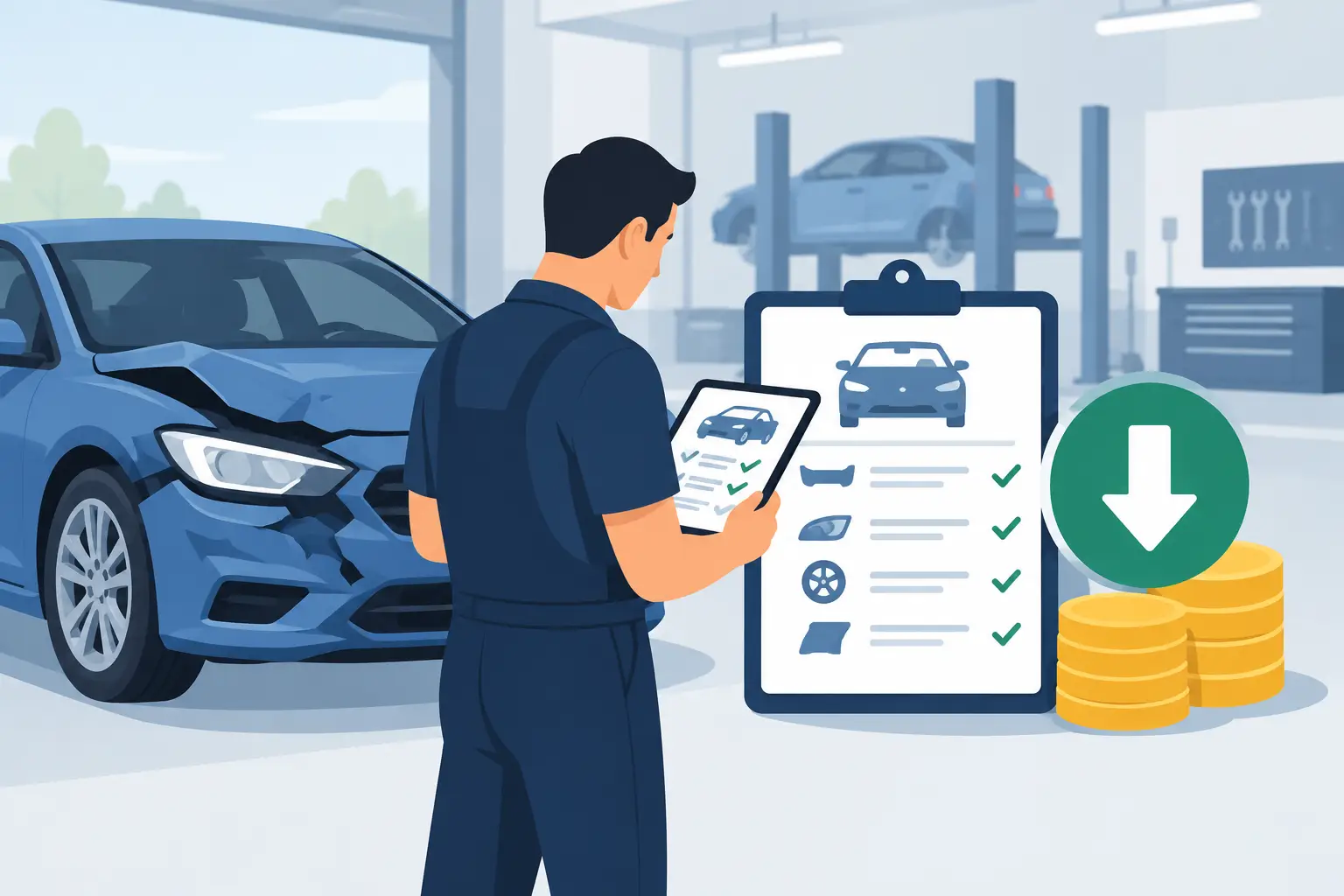
Create a complete visual record before disassembly changes the vehicle’s appearance. Wide-angle images should establish each side of the vehicle, overall impact zones, VIN, odometer, roof, undercarriage when accessible, and all four corners. Closer images should identify damaged panels, lamps, glass, wheel and suspension components, restraint-system evidence, fluid leaks, structural deformation, and prior unrepaired damage.
Photo quality is not cosmetic. Images should be clear, time-stamped through the management platform where possible, and labeled consistently enough that an appraiser, desk reviewer, or arbitrator can connect them to line items. A useful convention ties each image set to the estimate operation, such as right-front suspension, left-rear quarter, or front radar sensor area.
The estimate should reflect a repair plan rather than a preliminary visual opinion. Include teardown findings, measurements, diagnostic scans, calibration requirements, OEM procedure references where required by the repair plan, and all known parts and materials. Even when the carrier moves quickly to total the vehicle, the documentation should show why repairability concerns existed. On late-model vehicles, hidden structural damage, deployed restraints, battery damage, sensor replacement, and post-repair calibration can materially change severity.
Separate Collision Damage From Prior Condition
Prior damage is one of the most common sources of friction in total-loss handling. Photograph and describe it separately from loss-related damage. Record pre-existing corrosion, paint failure, worn tires, mechanical defects, prior repairs, missing trim, aftermarket modifications, and unrelated panel damage.
This separation is commercially significant. It gives claims teams a cleaner basis for valuation adjustments and prevents repair operations from carrying non-loss conditions into a repair-cost calculation. It also helps the vehicle owner understand why visible condition may affect value even when it was not caused by the current accident.
Preserve the Valuation and Repairability Evidence
A defensible total-loss file includes the valuation package used to support the settlement, along with the repair-cost basis available at the time of the decision. Retain the market valuation report, comparable-vehicle data, condition adjustments, options verification, taxes and fees where applicable, deductible, salvage value, and the applicable threshold or total-loss formula.
Do not assume that a valuation report is self-explanatory. Document the source used to verify trim, driveline, packages, mileage, and optional equipment. A vehicle decoded as a base model when it is actually equipped with advanced driver assistance systems, premium wheels, or a higher trim package can produce a settlement dispute and delay title release.
The repair-versus-total analysis also needs context. If an estimate was prepared before full teardown, mark it as preliminary and retain subsequent findings. If the unit was deemed non-repairable due to fire damage, flood exposure, severe unibody deformation, high-voltage battery compromise, or another safety concern, record the factual evidence and the party making that determination. Avoid vague notes such as “not safe to repair.” State the observed condition, the procedure or escalation path used, and the inspection evidence available.
Control Storage, Towing, and Vehicle Custody
Total-loss cycle time can erode claim economics quickly when vehicles sit at repair facilities or tow yards. Every file should show where the vehicle is located, the daily storage rate, the date storage began, who has authority to release the vehicle, and the planned next movement.
When a tow occurs, retain the tow authorization, pickup and delivery dates, originating and destination addresses, condition report, key count, and signed release. If a carrier or salvage vendor directs the move, record the assignment number and contact information. If the owner refuses release or elects to retain the vehicle, document that election promptly and escalate any title, lien, or storage issue before charges accumulate.
For collision centers, this process is also a capacity-management issue. A totaled vehicle occupying a production space or exterior lot position has an opportunity cost beyond its storage balance. Daily status reviews should identify vehicles awaiting appraisal, settlement acceptance, title documents, owner release, salvage assignment, or transport. The exception list should have an owner, not simply a status code.
Document Owner Communication and Required Notices
Customer communication belongs in the claim record. Save settlement offers, valuation reports delivered to the owner, owner-retention options, lienholder correspondence, release requests, and documented attempts to contact the customer. If communication occurs by phone, enter a concise factual note covering the date, participants, decision requested, and agreed next step.
State requirements vary substantially around salvage titles, owner retention, disclosure, branded-title processing, and storage notifications. Organizations operating across multiple states should use jurisdiction-specific workflows rather than relying on a single national checklist. The file should show which notice was provided, when it was sent, and by what delivery method.
Privacy controls matter as well. Total-loss files routinely contain registration details, financial information, driver-license images, lien documents, and contact data. Limit access by role, use approved document repositories, and avoid transmitting sensitive records through unsecured personal email or text threads. A complete file that is poorly controlled creates a different category of risk.
Use a File Standard, Not Individual Memory
The most reliable approach is a standardized digital file structure that follows the vehicle through inspection, settlement, release, and salvage disposition. It should require core records before a file can advance, while still allowing teams to flag exceptions such as inaccessible vehicles, police holds, biohazard conditions, disputed ownership, or EV battery quarantine.
A practical standard normally includes identity verification, intake photos, damage photos, estimate and teardown records, diagnostic evidence, valuation support, custody documents, communication history, title and lien status, and final release or disposition confirmation. The exact mix depends on the carrier, state, and vehicle condition, but consistency is what makes the record operationally useful.
Managers should audit a sample of closed total-loss files for missing documents, unsupported adjustments, excess storage days, delayed transfers, and repeated handoff failures. Those findings can expose process gaps in estimating, front-office intake, towing coordination, or salvage assignment before they become systemic leakage.
A well-documented total loss does more than support a settlement. It frees repair capacity, shortens storage exposure, strengthens audit readiness, and gives the customer a clearer path out of an already disruptive event. In a claims environment shaped by higher repair complexity and tighter throughput, that discipline is a measurable operating advantage.